Gamification in College Education: What the Research Actually Shows
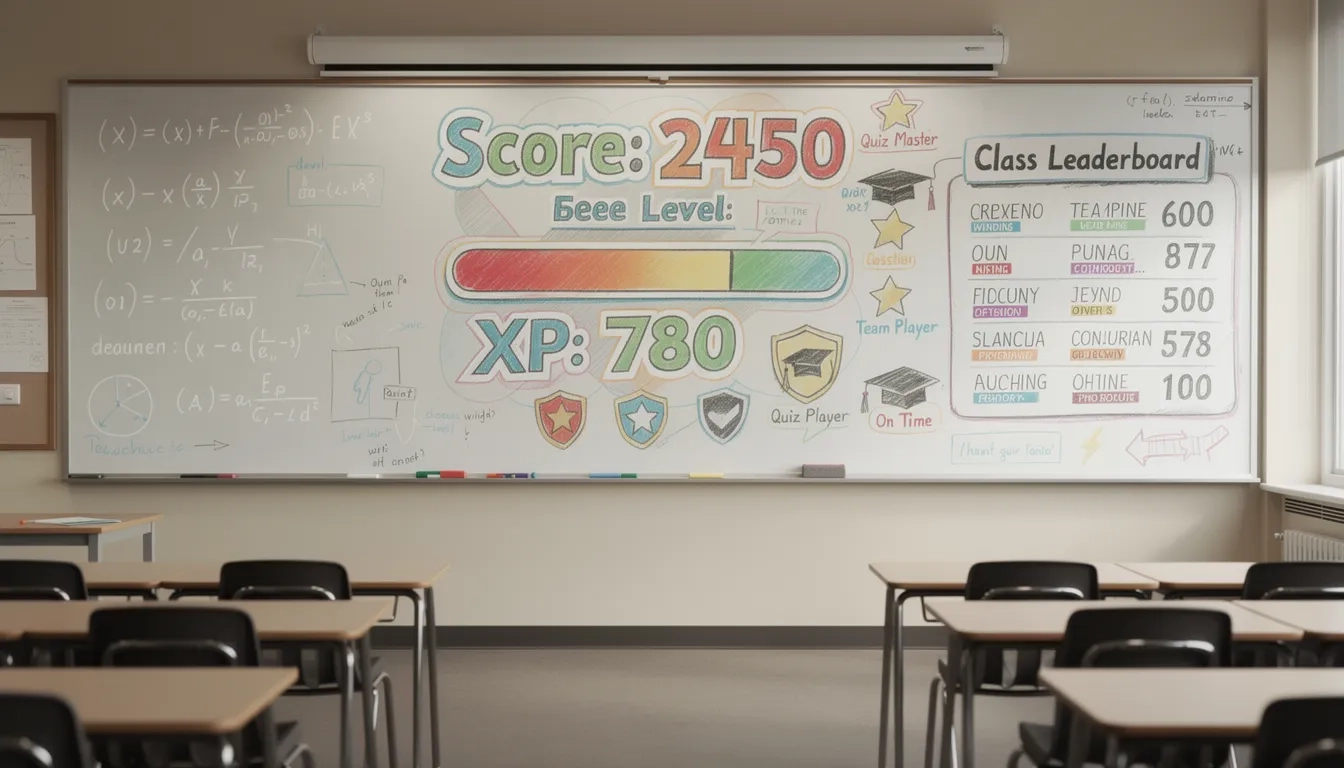
Picture a college classroom where students are genuinely competing to answer questions about thermodynamics. Not because it's on the exam. Because the leaderboard resets in four minutes and someone else is three points ahead.
That's gamification working. But it doesn't always work — and the gap between "works brilliantly" and "wastes everyone's time" is wider than most instructors expect.
What Gamification Actually Means in College Courses
Gamification is the application of game mechanics — points, levels, badges, leaderboards, streaks — to non-game contexts. In higher education, that usually means courses, assignments, or even entire degree programs structured around progression systems.
It is not the same as educational games. A trivia app built for learning is a game. Adding a point system to your existing syllabus is gamification. The distinction matters because the research treats them separately, and the outcomes differ.
The most common elements in higher ed e-learning are points, badges, and leaderboards (often called PBL), plus levels and real-time feedback. These are the building blocks. How you combine them determines almost everything about whether your implementation helps or hurts.
The MDE Framework: Structure Matters More Than You Think
Researchers describe game design through a model called Mechanics, Dynamics, and Esthetics (MDE). Mechanics are the rules (earn 10 points per quiz). Dynamics are the behaviors those rules produce (students attempting quizzes repeatedly). Esthetics are the emotional responses: fun, competitiveness, curiosity.
A meta-analysis covering 41 studies and 5,071 participants found that using the full MDE framework produced an effect size of g = 1.285. Strong result. Drop the Mechanics layer and use only Dynamics and Esthetics? The effect size collapses to g = -3.162. Students performed worse than those in traditional courses.
The lesson isn't subtle. Slapping a leaderboard on your course without structural rules isn't just ineffective. It actively backfires.
The Numbers Behind the Claims
That same meta-analysis found an overall effect size of g = 0.822 for gamified higher education. By conventional benchmarks, that's a large effect — well above the 0.40 threshold researchers typically call "substantial."
But the headline number hides wild variation. Science courses showed an effect size of g = 3.220. Math came in at g = 2.005. Business? A near-invisible g = 0.031.
The evidence for gamification is strong in STEM and nearly nonexistent in business education — at least based on what's been studied so far.
A separate study from the National Technical University of Athens found that gamification improved student achievement by 89.45% compared to traditional teaching methods. That figure is striking, though it reflects a specific intervention, not a universal guarantee.
Duration matters too. Interventions lasting longer than one semester produced an effect size of g = 3.304. Shorter ones were far weaker. Gamification isn't a one-lecture trick — it needs time to reshape student habits.
Where It Shines and Where It Doesn't
The subject-area gap is one of the most non-obvious findings in this field. Science and math respond strongly to game mechanics, probably because those disciplines involve frequent, discrete problem-solving steps that pair naturally with point-scoring and immediate feedback loops.
Business courses lean heavily on case discussion, ambiguity, and judgment. Rewarding a student with points for a "correct" answer in a business ethics debate is awkward at best. The content resists binary win-lose mechanics.
Setting matters too. The meta-analysis found substantially larger effects in offline (face-to-face) settings than online ones. That's counterintuitive, given how much edtech energy goes into digital platforms.
Here's how the key effect sizes compare:
| Context | Effect Size (g) |
|---|---|
| Science discipline | 3.220 |
| Math discipline | 2.005 |
| Business discipline | 0.031 |
| Full MDE framework | 1.285 |
| Dynamics + Esthetics only | -3.162 |
| Interventions > one semester | 3.304 |
| Overall (all studies, n = 5,071) | 0.822 |
One more counterpoint worth noting: the same research found elementary school learners benefited most from gamification (g = 1.293), while secondary school students barely moved (g = 0.014). College sits in a complicated middle ground. Instructors can't assume the enthusiasm that works with younger learners will carry over automatically to undergraduates who've already seen these tricks before.
Real-World Evidence: Kahoot and Duolingo
You've almost certainly seen Kahoot in action — the quiz platform that turns multiple-choice questions into a timed competition with music and a running scoreboard. It's become one of the most widely used gamification tools in higher ed.
A longitudinal study from the University of Sharjah in the UAE used Kahoot in an online French language course across three full academic terms. The result was "consistently high student enthusiasm and engagement" even when the tool was used twice per session. That's meaningful: repetition without obvious fatigue is hard to sustain.
But Kahoot also illustrates a real tension. Some students find the competitive format genuinely stressful. Others report that watching the same two or three classmates top the leaderboard every week is demoralizing, not motivating. Leaderboard fatigue is documented, not anecdotal.
Outside formal education, Duolingo's numbers are instructive (though not from a controlled study). By applying streaks, leaderboards, and in-game currency, the app reduced user churn from 47% to 28% and recorded a 36% year-over-year increase in daily active users as of 2025. That's a commercial product at scale, not a classroom experiment. But it shows these mechanics can hold attention over time when the design is thoughtful.
The Competition Problem
- Some students thrive on leaderboard competition; others disengage when they feel they can't win
- Leaderboard fatigue sets in when rankings feel fixed rather than fluid
- Cooperative mechanics (team points, shared badges) often reduce stress without sacrificing engagement
- Anonymous or opt-in leaderboards are a sensible workaround that preserves student choice
Common Mistakes Professors Make
The writing was on the wall for "add badges and call it gamification" as early as the first serious studies emerged. Yet it's still the most common implementation failure in college courses.
Here are the patterns that reliably don't work:
- Points without feedback — Awarding points that tell students nothing about their actual performance. A score is not the same as a signal.
- One-off gamified sessions — A single Kahoot quiz in week three is a novelty, not a system. Duration data is clear on this.
- Ignoring student differences — Competitive mechanics motivate some students and alienate others. One-size mechanics are a design flaw, not a minor detail.
- Skipping the Mechanics layer — Using Dynamics (behaviors) and Esthetics (emotions) without structural rules is the scenario that produced a negative effect size.
- Gamifying the wrong content — Discussion-heavy, judgment-oriented material (common in humanities and business) resists point-scoring logic by nature.
The good news is that these are design errors, not fundamental flaws in the concept itself.
How to Build a Gamified Course That Actually Holds Up
If you're an instructor thinking through this, the research points toward a few concrete choices.
Commit to a full semester, at minimum. The effect-size data for longer interventions isn't ambiguous. A brief gamified unit is unlikely to shift student habits or achievement in any lasting way.
Start with the Mechanics layer. What are the rules? What earns points? What triggers a badge? Get specific before worrying about aesthetics or which platform to use.
Then think about Dynamics. What behaviors do you actually want? More practice problems attempted? More revision cycles before submission? More peer explanation? Design your mechanics to produce those behaviors — not just engagement for its own sake.
A practical design checklist:
- Define what behavior each mechanic is meant to reward
- Build in feedback that's informative, not just numerical
- Offer cooperative options alongside competitive ones
- Run the system for at least a full semester before drawing conclusions
- Default to STEM content if you're new to this — the effect-size data justifies the experiment there
My Take
The evidence is strong enough to say gamification in college is worth doing — in the right subjects, with real structural design, over a full semester. The 89.45% achievement improvement from Athens and the overall g = 0.822 across 5,071 participants aren't outliers.
But the negative effect size for poorly structured implementations (g = -3.162) is a warning that belongs on every edtech pitch deck in large print. The version of gamification most professors deploy — a quiz app here, a badge plugin there — is probably not the version that produced those strong results.
Science and math educators have the most to gain from this approach right now. Business educators should probably wait for more subject-specific research before assuming the tools will transfer cleanly.
Bottom Line
- Gamification in college education produces a meaningful overall effect (g = 0.822 across 5,071+ participants), but outcomes vary drastically by subject, framework quality, and duration
- Science and math show the strongest effects; business education shows almost none — match your subject before committing
- The full MDE framework (Mechanics + Dynamics + Esthetics) drives results; dropping the Mechanics layer produces negative outcomes, not neutral ones
- Competition mechanics help many students and demoralize others — cooperative alternatives aren't optional extras
- Commit to at least a full semester; short interventions consistently underperform in the data
Frequently Asked Questions
Does gamification work for online college courses?
Face-to-face settings produce larger effects than online ones, which should correct the assumption that gamification is primarily a digital tool. Online gamification can still work, but instructors should expect more modest gains and invest more in feedback quality to make up for the absence of in-person social dynamics.
Which game mechanics show up most often in higher education?
Points, badges, and leaderboards (PBL) dominate, along with levels and real-time feedback. These are the baseline. The research makes clear that combining them within a structured framework — particularly one that includes concrete Mechanics rules — is what separates effective implementations from decorative ones.
Is Kahoot effective at the university level?
The University of Sharjah study found strong, sustained engagement across three academic terms of an online French course, even with twice-per-session use. That's encouraging. But Kahoot's competitive format creates real stress for some students, and leaderboard fatigue is documented when rankings feel static. Using it as one element among several, rather than the whole gamification strategy, is the more defensible approach.
Can gamification actually hurt student performance?
Yes. The meta-analysis found a negative effect size of g = -3.162 for implementations using Dynamics and Esthetics without the underlying Mechanics layer. Poorly designed systems can reduce performance below what no gamification at all would produce. This is the most important finding in recent research and the most frequently ignored one.
What subjects benefit most from gamification in college?
Science and math show the strongest effects by a wide margin (g = 3.220 and g = 2.005 respectively). Business education showed a near-zero effect (g = 0.031). Subjects built around discrete, assessable tasks with clear right-or-wrong answers pair better with point-based mechanics than subjects built around open-ended judgment or debate.
How long does a gamified course need to run before you'll see results?
Longer than one semester appears to be the threshold. The meta-analysis found an effect size of g = 3.304 for interventions running beyond a single semester, compared to substantially weaker results for shorter implementations. If you're planning to evaluate your gamified course after just a few weeks, you're measuring the novelty effect, not the learning effect.
Sources
- Examining the effectiveness of gamification as a tool promoting teaching and learning: a meta-analysis (PMC)
- Exploring the impact of gamification on students' academic performance: A meta-analysis 2008–2023 (British Journal of Educational Technology)
- Impact of a game-based tool on student engagement in a foreign language course: a three-term analysis (Frontiers in Education)
- From Engagement to Achievement: How Gamification Impacts Academic Success in Higher Education (MDPI Education Sciences)
- How Gamification in Education is Transforming EdTech in 2024 (TechResearchOnline)
- Duolingo gamification explained (StriveCloud)