Temple University: Programs, Rankings, and Student Life Guide
Russell Conwell didn't set out to build a research university. In 1884, he opened evening classes in North Philadelphia for working-class people who held jobs during the day — dockworkers, factory hands, anyone who wanted an education but couldn't afford to quit working for it. That origin story still echoes through everything Temple does today. The school now enrolls 30,005 students, runs 17 schools and colleges offering 640+ academic programs, and has made the US News top 50 public universities three years running as of 2025. The scrappy-underdog identity never fully left, and for many applicants, that turns out to be exactly the draw.
What the Rankings Actually Tell You
Temple's headline 2025 number is #49 among Top Public Schools — its third consecutive year in that tier. The overall national rank is #102, which sounds less impressive until you look at what sits beneath the surface.
Graduation Rate Performance is #46 nationally. That's not a vanity stat. It means students who enroll at Temple actually finish. Schools with weak advising and poor support systems show up badly in this category. Temple doesn't.
The Best Value rank is #81, combining cost and academic quality. For Pennsylvania residents paying $9,804 per semester in base tuition, that's a meaningful signal — not marketing copy.
| Category | 2025 US News Rank |
|---|---|
| Top Public Schools | #49 |
| National Universities | #102 |
| Best Value | #81 |
| Graduation Rate Performance | #46 |
| Best Colleges for Veterans | #67 |
| Undergraduate Psychology | #43 |
The psychology program's jump of 25 spots in a single year to land at #43 nationally is worth examining separately. One-year movements that large usually indicate a significant faculty shift, curriculum overhaul, or methodology change at US News. Whatever drove it, the result is now on record and reflects a department that has invested seriously in research output.
One honest caveat: national rankings measure inputs and outputs, not fit. Temple's rank should be one data point in your decision, not the entire argument.
Fox School of Business: Stronger Than Its Overall Rank Suggests
Fox is Temple's most recognizable academic brand. It earns that status through specific program performance, not general prestige.
The insurance undergraduate program ranks #7 nationally — a niche that gets almost no attention in college search conversations, but one with direct pipelines to Philadelphia's large financial and insurance sector employers. International business sits at #15, management information systems at #19. Those are consistent top-20 finishes for a public school competing against flagship state universities with endowments three times Temple's size.
The Fox part-time MBA holds at #91 nationally. That's not a top-10 program. But for a working professional in the Philadelphia region who needs evening and weekend classes without relocating or stepping off the career track, the cost-to-outcome ratio is genuinely competitive. Classes run at hours that accommodate full-time work, and the alumni network in the region is dense.
My read is that Fox gets undersold because it lacks the name recognition of Wharton in Philadelphia conversations. But if you look at where Fox graduates actually work — and the city's financial, insurance, and healthcare sectors are full of them — the employment data tells a different story than the overall business school ranking.
The broader Fox curriculum also covers real estate, risk management, actuarial science, and supply chain management. For students who know what sector they want to enter, Fox's program depth often beats what a higher-ranked generalist business school offers.
Beasley School of Law: Trial Work Is Where It Shines
The James E. Beasley School of Law ranks tied at #50 overall in US News's 2025 law school rankings. Middling, on the surface. The meaningful numbers are inside.
Trial advocacy: #2 in the country. Legal research and writing: #5. The part-time evening program: #9. If you plan to litigate — actually stand in a courtroom and argue cases — Beasley trains students in those specific skills better than almost any law school in America. The overall rank buries that.
For students focused on courtroom work, rankings by specialty matter more than the headline number. A student who graduates from a #50 school ranked #2 in trial advocacy often walks into a prosecutor's office or litigation firm with more practical skill than someone from a school ranked #30 overall with no particular courtroom training.
Beasley also runs the only ABA-accredited semester program in Japan — a detail that sounds minor until you realize most law schools with international programs default to London or Brussels. Temple went to Tokyo, and it has maintained that program for years. For students pursuing international law careers with an Asia-Pacific focus, that's a real differentiator.
The part-time evening program deserves one more mention: ranking #9 in the country means that working professionals in Philadelphia can earn a law degree from a nationally ranked program without putting careers on hold. That's rare at this quality level.
Medicine, Research, and the Professional Schools
Lewis Katz School of Medicine made history in July 2014 when its scientists became the first in the world to successfully remove HIV from human cells. That's not a marketing claim — it's a documented scientific milestone. Research at that level reflects genuine institutional investment in faculty and lab infrastructure, not luck.
Temple spent $301.4 million on research and development in 2022, ranking 98th among all U.S. universities. That places it firmly in the category of research universities, not primarily teaching institutions. The R&D spending funds work across medicine, engineering, and basic sciences.
The Kornberg School of Dentistry is one of the largest dental programs in the country, training a significant share of practicing dentists across Pennsylvania and neighboring states. Pre-dental students comparing in-state options often overlook it in favor of Penn, but Kornberg's clinical training volume is substantial.
Beyond the hard sciences:
- Boyer College of Music and Dance is five miles from the Kimmel Center for the Performing Arts, home to the Philadelphia Orchestra. Students don't just study music; they're embedded in a working professional arts ecosystem.
- Tyler School of Art and Architecture feeds directly into Philadelphia's active creative economy, producing graduates who show in galleries and work in architecture firms across the region.
- Klein College of Media and Communication places graduates at virtually every major broadcast outlet, newspaper, and digital media operation in Philadelphia.
What Student Life Actually Looks Like
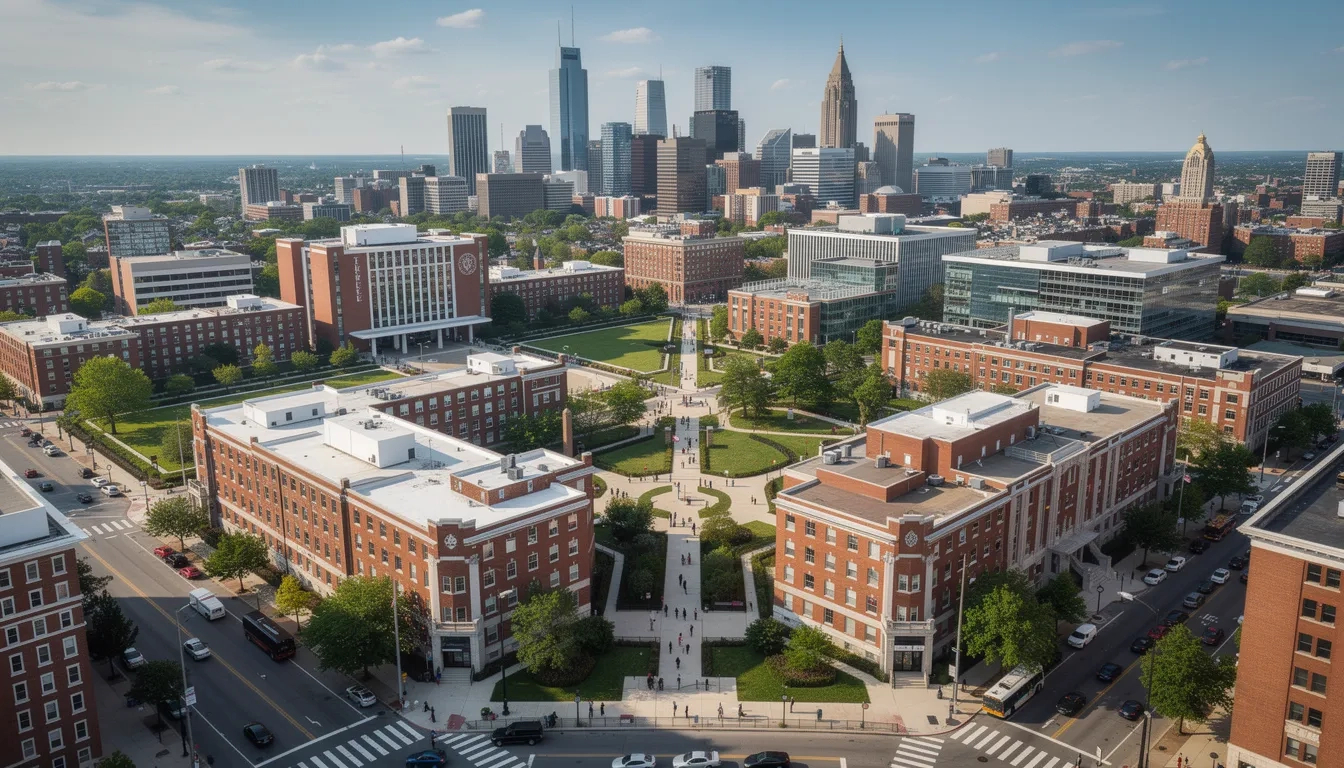
Temple's main campus covers 118 acres in North Philadelphia — compact for a school of 30,000 students, which means you run into classmates constantly, and the campus has the energy of a place where things are actually happening.
The city integration is real. A subway ride of roughly 20 minutes puts students in Old City, Rittenhouse Square, or Fishtown. More than 149,000 Temple alumni live and work in the Philadelphia region, which creates an internship and professional network that students can begin accessing before graduation. Philadelphia hosts major employers in healthcare, financial services, education, law, and government — and Temple students are woven into that fabric through co-ops and part-time roles while still enrolled.
Student organizations number over 330. That range covers pre-professional clubs, cultural organizations, academic societies, and recreational sports. Temple also competes at the NCAA Division I level in the American Athletic Conference — football and basketball at the Liacouras Center draw serious crowds, and former Owl DeSean Jackson is among the program's notable NFL alumni.
Campus safety is what families raise first, and it deserves a direct answer. Temple operates the largest university police department of any university in the United States, with 130 uniformed officers, along with the TUsafe app for direct contact with campus public safety. Students consistently report feeling secure on campus. The surrounding neighborhood requires standard urban awareness after dark — the same judgment you'd exercise in any major city. That's the honest summary.
The Temple Promise program extended financial support to 489 students during 2024-2025, all from Philadelphia. The incoming class that year included more than 1,000 city residents, a 68% jump from the prior year. Temple is actively changing who can access a four-year degree in Philadelphia, and the enrollment data shows it's working.
What It Actually Costs
Pennsylvania residents pay $9,804 per semester in base tuition for 2025-2026. Out-of-state: $17,616 per semester. Mandatory fees add $528 per term. Total in-state costs typically land between $32,000 and $38,000 per year depending on housing choices — well below comparable private universities anywhere in the Philadelphia area.
Temple expects to award $184 million in financial aid to undergraduates this year, up $35 million from the previous year. About 79% of enrolled students receive grants or scholarships. The average award is $12,143. For many in-state students, the combination of aid and in-state tuition makes Temple's net price competitive with schools that carry a much lower sticker price.
The Temple Promise program supplements standard financial aid for eligible Philadelphia residents, covering costs that loans otherwise wouldn't reach. It's a meaningful program for lower-income students from the city. The 68% increase in Philadelphia enrollment isn't accidental — it reflects what happens when you make cost a genuinely solvable problem.
Temple's overall acceptance rate sits around 72%, which makes it accessible to most applicants with solid academic records. But admission to the university does not mean admission to its professional schools. Beasley, Lewis Katz, Kornberg, and selective undergraduate honors tracks all run their own more competitive processes on top of general admission.
Bottom Line
- In-state students weighing public university options should place Temple near the top of the list. The combination of Fox's top-20 business programs, Beasley's litigation-focused legal training, and research-grade medicine and pharmacy at public-school tuition rates is difficult to match within Pennsylvania.
- Pre-law students focused on courtroom work should treat Beasley's #2 trial advocacy ranking as a more meaningful data point than the school's overall #50 placement.
- The urban location is both the asset and the concern. Students who actively use Philadelphia for internships, cultural life, and professional networking tend to have a richer four-year experience than those who don't venture off campus.
- Financial aid has expanded significantly. Run the net price calculator before ruling Temple out on cost — 79% of students receiving aid at an average of $12,143 is a different reality than the sticker price suggests.
- Temple works best for students who want a real city, real professional proximity, and the flexibility to design an education across 640+ programs. It is not the right fit for students who want a tight-knit residential campus far from urban life. Know which one you're looking for.
Frequently Asked Questions
Is Temple University a good school for business?
Fox School of Business ranks in the top 20 nationally for international business (#15) and management information systems (#19) at the undergraduate level, and its insurance program sits at #7. The school is the largest business program in the greater Philadelphia region. The Fox part-time MBA is ranked but not elite; for working professionals in the local market, the value and scheduling flexibility compete well with higher-ranked alternatives that cost significantly more.
What is Temple best known for academically?
Beasley School of Law's #2-ranked trial advocacy program, Fox School of Business's sector-specific undergraduate rankings, and Lewis Katz School of Medicine's HIV-removal research are the most notable individual achievements. Temple's broader identity is breadth — 640+ programs across 17 schools means it has genuine depth in dentistry, pharmacy, art, music, education, and communication in addition to the professional schools. There isn't one singular academic signature; the range is the identity.
Is it a myth that Temple is unsafe?
Partially. The campus itself is well-patrolled — Temple runs the largest university police department in the U.S. with 130 officers — and students report feeling secure within campus boundaries. The surrounding North Philadelphia neighborhood does have elevated crime rates compared to other parts of the city. Students who apply standard urban awareness (don't walk alone late at night in unfamiliar areas, use the TUsafe app) generally have uneventful experiences. Treating "Temple is dangerous" as a blanket statement misrepresents the on-campus reality; ignoring the off-campus context entirely would also be wrong.
How do I actually use Philadelphia as a Temple student?
Philadelphia's SEPTA subway system connects campus to Center City, South Philly, and neighborhoods like Fishtown and Old City in 20–30 minutes. Temple's co-op and internship infrastructure places students at employers across healthcare, finance, media, and law within the city during the school year — not just summers. The 149,000 Temple alumni in the Philadelphia region form a professional network students can access through the alumni office before graduation.
What should I know about Temple's professional school admissions?
General admission to Temple University does not guarantee entry to its professional schools. Beasley School of Law, Lewis Katz School of Medicine, and Kornberg School of Dentistry all run independent, competitive admissions processes. Undergraduate students interested in these schools should research program-specific prerequisites and admissions statistics early, typically starting in their sophomore year, well before application deadlines.
Does Temple offer good financial aid compared to peer schools?
Temple expects to distribute $184 million in undergraduate financial aid in 2025-2026, with 79% of enrolled students receiving grants or scholarships averaging $12,143. That positions Temple's aid generosity above many comparable public universities in the region. Philadelphia residents who qualify for Temple Promise can receive additional support beyond standard aid packages. Running the net price calculator (available on Temple's financial aid website) is the fastest way to see your actual cost, which often differs sharply from published sticker prices.
Sources
- US News ranks Temple among top 50 public universities for 2025 | Temple Now
- Temple University recognized in 2025 US News Best Graduate School rankings | Office of the President
- Student Life – Undergraduate Admissions | Temple University
- Temple University – Wikipedia
- Temple University (Beasley) Law School Rankings | US News
- The first Temple Promise cohort shines in 2024–2025 school year | Temple Now