How Universities Fight Academic Fraud with Technology
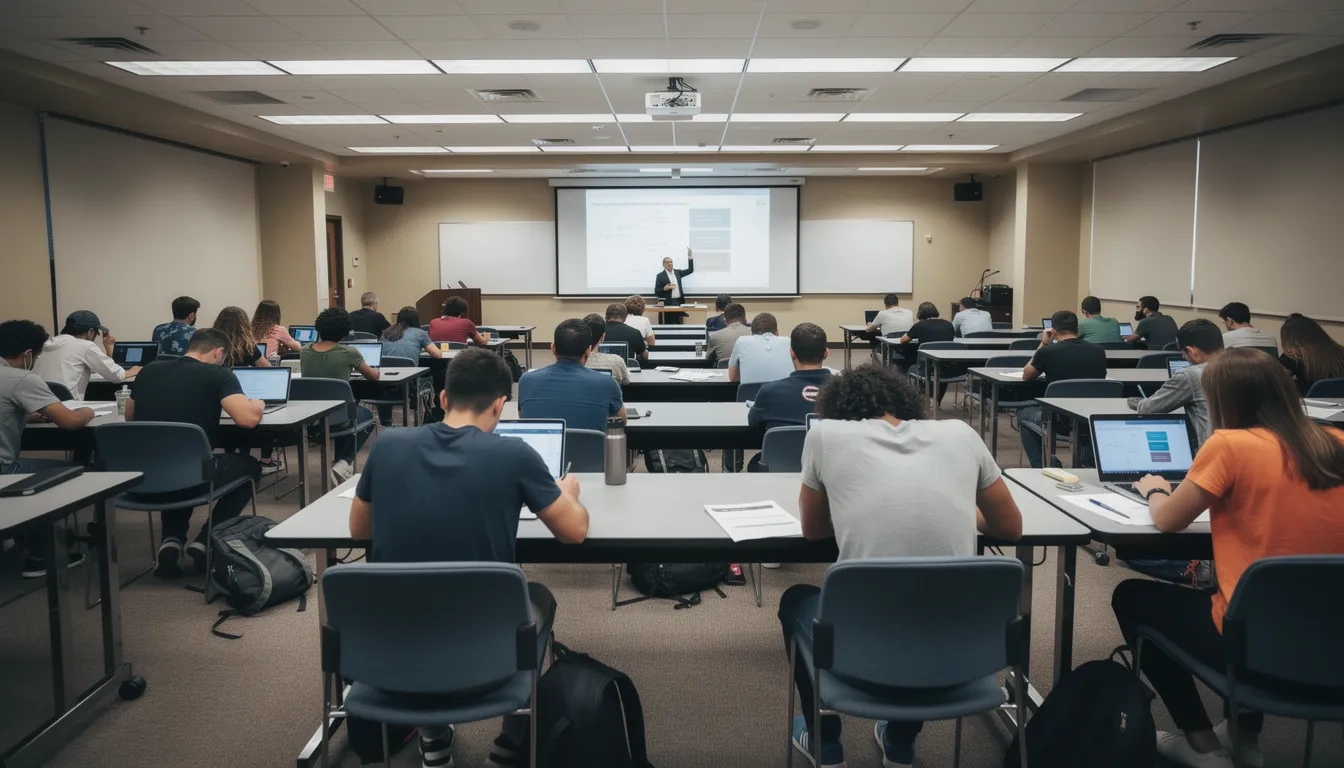
89% of college students have used ChatGPT for homework. Universities spent more than $15 million across 57 California institutions alone trying to catch them. And the tools doing the catching? Wrong roughly 1 in 3 times. If that sounds like an arms race nobody's winning, that's because it mostly is.
But framing this as student vs. detector misses most of what universities are actually doing. The detection wars are loud, but they're one front in a broader effort. Schools are also deploying biometric identity verification during exams, blockchain-backed credentials that make fake degrees nearly impossible to forge, and behavioral analytics that flag anomalies before a proctor ever reviews a single video. The picture is more complicated, and more interesting, than "Turnitin caught my essay."
Why Academic Fraud Got So Much Harder to Ignore
For decades, traditional plagiarism mostly meant copying someone else's words and hoping the professor didn't recognize them. Detection was manual, inconsistent, and relatively easy to evade. Then came contract cheating sites — essay mills where students paid human writers to complete entire assignments. The UK's Quality Assurance Agency estimated around 17,000 students used these services annually before contract cheating became a criminal offense there in 2024.
Then generative AI arrived and scrambled every prior assumption.
A 2025 survey found 95% of the academic community believes AI is being misused at their institutions. Essays that read perfectly but don't match a student's in-class performance. Code that works but the author can't explain. The usual behavioral signals of cheating stopped being reliable overnight.
Credential fraud runs parallel to all of this. Some estimates put the share of job applicants who misrepresent their academic credentials at around 40%. That's a number worth sitting with — it's not students gaming a homework submission, it's fake degrees circulating in hiring pipelines.
The Plagiarism Detection Gold Rush
Turnitin is the undisputed giant here. The platform launched in the late 1990s, originally matching text against a database of web pages, journals, and prior submissions. By 2023 it had added an AI writing detection layer, and universities rushed to pay for it.
The spending numbers are striking. According to records obtained by The Markup, California's 57 higher-ed institutions collectively spent more than $15 million on plagiarism detection tools. UC Berkeley locked in a 10-year contract worth approximately $1.2 million. Cal State spent $6 million with Turnitin since 2019, then paid an additional $163,000 in 2025 specifically for the AI detection add-on. College of the Canyons, a community college in Santa Clarita, paid $47,000 in a single year — compared to $120 back in 2004.
Newer entrants like GPTZero, Copyleaks, and Originality.ai have carved out market share by focusing specifically on AI-generated content. They use classifiers trained to identify "burstiness" and perplexity patterns — essentially, the statistical predictability that language models produce versus the messier, more erratic rhythms of human writing.
The logic is sound. The execution is shakier.
The False Positive Problem Nobody Wants to Acknowledge
Here's the uncomfortable fact: AI detection tools flag innocent students at a rate that should disqualify them from being used as disciplinary evidence.
A 2026 study placed commercial detector accuracy between 61% and 69%. That's roughly 1 in 3 flagged submissions being potentially wrong. Worse, the errors aren't random. Research found Black students were twice as likely as white and Latino students to receive false flags. Non-native English speakers face similar disparities — their writing can superficially resemble AI output because both tend toward simpler structures and more formulaic constructions.
Mike Perkins, a researcher on academic integrity at British University Vietnam, said these tools are "not fit for purpose." The University of Pittsburgh's Teaching Center reached the same conclusion, advising faculty that current detection software carries too high a false positive risk to use as the primary basis for disciplinary action.
"Ed tech does a good job of convincing you that it is 100% necessary for education. That's its big lie." — Sean Michael Morris, educator and critical pedagogy scholar
One in five surveyed high school students reported being wrongly accused of AI cheating. Students adapted quickly: running their own papers through detectors before submitting, adding deliberate typos, rewriting flagged sentences. The detector becomes a formatting target rather than a deterrent.
The tools keep getting purchased because they give administrators something legible to point at. Whether they're working is a different question — and most administrators don't want to ask it publicly.
Online Proctoring: Watching You While You Test
The other major tech front is remote exam proctoring — software that monitors students during online tests. This category exploded during COVID-19 and never fully retreated.
How it works in practice:
- Before the exam, the student scans a government-issued ID and completes a facial recognition check
- During the exam, AI monitors webcam and microphone feeds continuously
- Behavioral analytics flag anomalies: unusual eye movement patterns, typing cadence shifts, background voices, browser tab switching
- Human reviewers watch flagged clips afterward and decide whether to escalate
ProctorU (now part of Meazure Learning) uses biometric keystroke analysis — your typing rhythm is distinctive enough to serve as a soft identifier. If test-taker keystrokes diverge sharply from a session baseline, that triggers a review queue.
| Technology | What It Monitors | Main Limitation |
|---|---|---|
| Turnitin / GPTZero | Text similarity and AI writing patterns | High false positive rate, especially for non-native writers |
| ProctorU / Respondus | Live video, keystroke dynamics, browser | Privacy invasiveness, bedroom scanning requirements |
| Facial recognition check-in | Pre-exam identity match | Accuracy gaps across skin tones |
| Blockchain credentials | Diploma and transcript authenticity | Addresses credential fraud only, not assignment fraud |
The privacy criticism is substantial. The Dutch Data Protection Authority ruled in 2023 that some proctoring tools violated GDPR. In the US, several universities faced student protests over software requiring scans of personal living spaces before exams could begin. A 2025 Australian study found no statistically significant difference in academic integrity outcomes between proctored and unproctored online exams when the assessments were thoughtfully designed. That finding doesn't get cited much in proctoring sales pitches.
Blockchain: Attacking Credential Fraud at the Source
While the detection arms race dominates headlines, blockchain-based credentialing is quietly solving a different and arguably more durable problem: the forged diploma.
MIT launched its Digital Diploma program using Blockcerts, an open-source standard, letting graduates receive cryptographically signed credentials they can share directly with employers without involving MIT's registrar. Verification is instant. Change a single character in the underlying data and the signature becomes mathematically invalid.
The University of Lille, in France, has issued over 60,000 blockchain-based diplomas since 2020. The University of Melbourne and Sony Global Education (in a partnership with IBM) have working systems too.
The fraud prevention logic is elegant. Traditional paper diplomas and even PDF certificates can be forged convincingly. Cryptographic signatures cannot. An employer scanning a blockchain-verified diploma isn't trusting the document's appearance — they're verifying a mathematical proof that the issuing institution signed this specific credential for this specific person.
Universities using blockchain credentialing report roughly 30% fewer fraud cases in credential verification. The holdback on wider adoption is standards fragmentation: some schools use Ethereum-based systems, others use private or hybrid blockchains. The open Blockcerts standard addresses this, but adoption isn't universal yet, which means some credentials can't be cross-verified across platforms.
What Actually Works: Redesigning the Assignment
The most honest observation from researchers who've spent years on this is also the least convenient one for ed-tech vendors: the best defense against academic fraud isn't detection — it's assessment design.
Students cheat on generic, reusable assignments. An essay question that any student in any semester could answer identically is also a question ChatGPT can answer identically. Assessments that require personal reflection, engagement with current materials, staged submissions with instructor feedback, or oral defense components are fundamentally harder to outsource.
Some universities are moving toward portfolio-based evaluation where students build a body of work over a semester, creating an audit trail that makes late-stage substitution obvious. Others use in-class verbal check-ins on submitted work. The University of Sydney formalized "assessment for learning" principles specifically to reduce the fraud window while also improving actual learning outcomes.
Detection tools still serve a supporting role — catching patterns that warrant a conversation, flagging submissions that look statistically unusual. But treating them as primary arbiters of integrity is asking the wrong tool to do the wrong job.
The hard truth is that academic integrity is ultimately a culture problem, not a technology problem. Tools raise the cost and effort of cheating. They catch some share of those who try. But the institutional pressures that push students toward fraud — brutal workload compression, high-stakes single assessments, inadequate mental health support — don't disappear because a new detector got added to the LMS.
Universities that get this right use technology as one layer in a broader system: blockchain credentials for downstream fraud prevention, proctoring for high-stakes certification exams, detection tools as conversation starters rather than verdicts, and better assessment design as the actual foundation.
Bottom Line
- Treat detection flags as the start of a conversation, not the end of one. A Turnitin or GPTZero score alone is not sufficient grounds for disciplinary action given current false positive rates. Institutions that use it that way will eventually face both wrongful accusation problems and legal exposure.
- Blockchain credentialing is worth adopting now. MIT's Blockcerts standard provides tamper-proof diploma verification at a fraction of the administrative cost of manual registrar confirmations, and the fraud prevention benefit is immediate.
- Redesign at-risk assessments before adding surveillance. A well-designed assignment closes more fraud opportunities than any detector. Staged submissions, oral check-ins, and personally-grounded prompts are hard to outsource.
- The technology spending is real and growing. The outcomes are genuinely mixed. Institutions that treat tech as a substitute for academic culture work will keep running harder without getting farther.
Frequently Asked Questions
Does Turnitin accurately detect AI-written submissions?
Only partially. Research through 2026 places AI detection accuracy across major commercial tools between 61% and 69%, meaning roughly 1 in 3 flagged submissions may be incorrect. Turnitin performs better at detecting verbatim text overlap than at reliably distinguishing AI prose from human writing, especially from non-native English speakers whose writing patterns can superficially resemble AI output.
Can students bypass AI detection tools?
Yes, and many do. Adding deliberate typos, paraphrasing flagged passages, using "humanizer" tools that restyle AI output, or simply editing and revising AI-generated text before submission all meaningfully reduce detection rates. This is one reason researchers consistently argue that detection alone is not a complete integrity strategy.
What is Blockcerts and how does it prevent diploma fraud?
Blockcerts is an open-source standard for blockchain-based academic credentials, originally developed at MIT. When a university issues a diploma via Blockcerts, the credential is cryptographically signed and recorded on a blockchain ledger. Anyone can verify it by checking the signature against the institution's public key — no phone call to a registrar, no delay, and no possibility of forging the underlying record.
Is online proctoring legal in all countries?
Not without restrictions. The Dutch Data Protection Authority ruled in 2023 that certain proctoring implementations violated GDPR. US institutions must navigate FERPA rules around student biometric and behavioral data. The most contested practices involve scanning students' personal living spaces and continuous biometric monitoring. Several universities now limit proctoring to high-stakes certification exams rather than routine coursework.
Myth vs. reality: Does more surveillance reduce cheating?
Not reliably. A 2025 Australian university study found no statistically significant difference in academic integrity outcomes between proctored and unproctored online exams when the assessments themselves were thoughtfully designed. Surveillance increases the effort cost of cheating but doesn't address the motivation behind it. Well-designed assessments show more consistent results without the collateral damage to honest students.
What should a student do if wrongly accused based on an AI detection flag?
Document your process immediately — keep drafts, notes, browser history, and research materials from before you submitted. Request a meeting with your instructor before any formal process starts, and ask specifically what evidence triggered the flag. Most institutions require more than a software score to initiate formal disciplinary proceedings. If the situation escalates, your university's student advocacy office can provide representation and help you understand your procedural rights.
Sources
- California colleges spend millions to catch plagiarism and AI (The Markup)
- Turnitin helps colleges detect AI writing — but its cost is more than just a price tag (CalMatters)
- AI Plagiarism Statistics 2025 (ArtSmart)
- How Blockchain Technology Is Securing Academic Credentials
- Evaluating the Effectiveness and Ethical Implications of AI Detection Tools in Higher Education (MDPI)
- Online Proctoring: Ensuring Exam Security in Remote Learning (SkillQ)