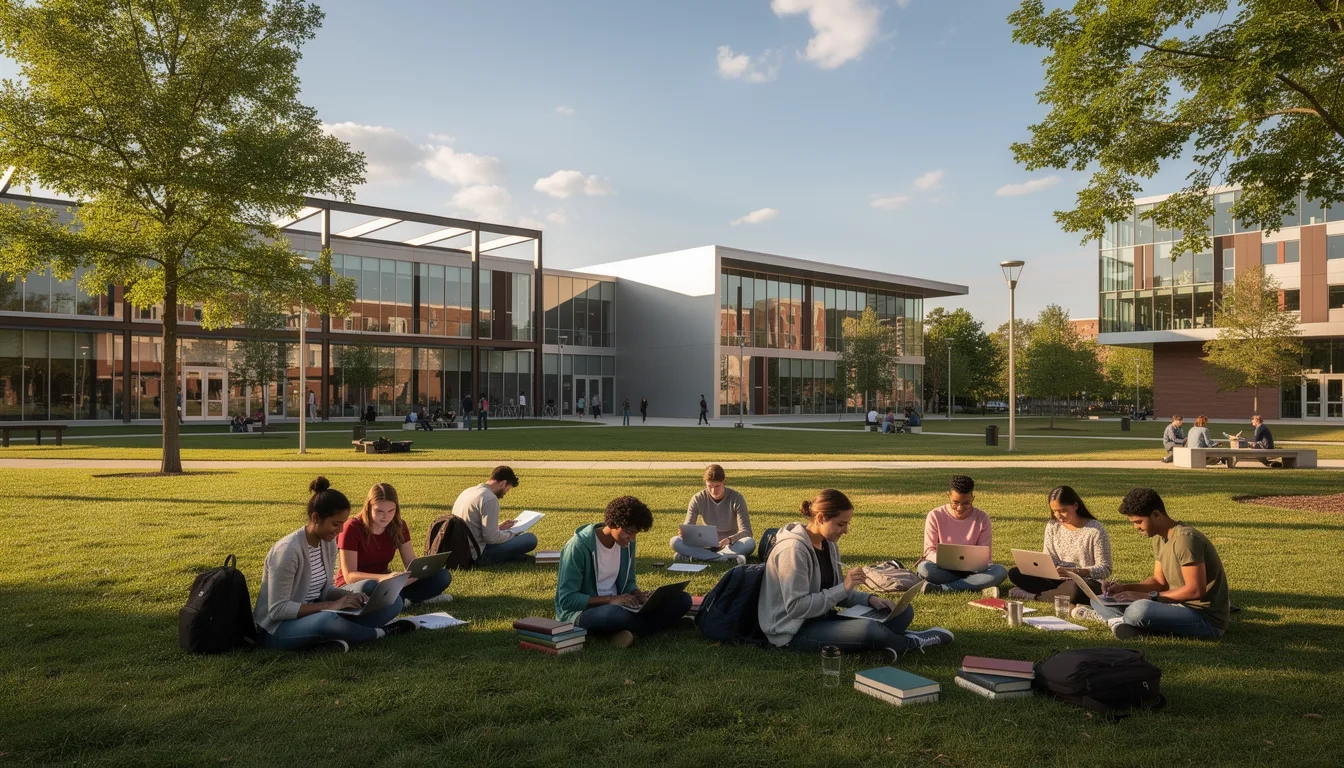
University of Chicago: Admissions, Rankings & Student Life Explained
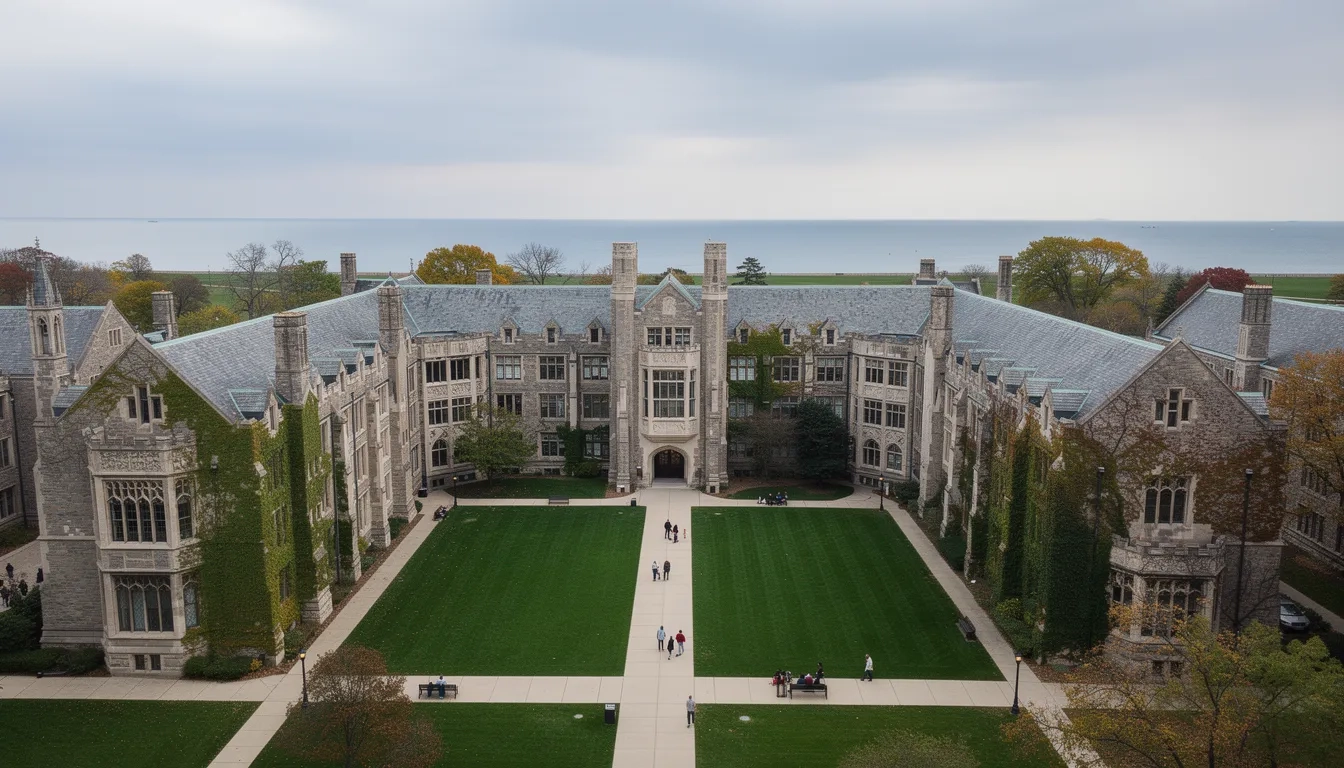
In September 2025, U.S. News & World Report moved the University of Chicago from #11 to #6 in its National Universities ranking. Five spots in one year. That kind of jump means something real — either the school earned it, or the methodology finally caught up to what the school already was. In UChicago's case, both arguments hold. The acceptance rate for the Class of 2028 sat at 4.48%, down from 8.4% a decade ago. Applications keep rising while the admitted class stays small. If you're figuring out whether UChicago belongs on your list, here's what the numbers actually show.
The Acceptance Rate Is More Complicated Than 4.48%
The headline: 43,612 students applied for the Class of 2028. 1,955 got in. That 4.48% overall rate conceals a more granular picture depending on your circumstances.
Unhooked applicants — those without athletic recruitment, legacy connections, or other institutional priorities — face odds closer to 1.5 to 3% through regular decision. Early Decision applicants see something more like 7-12%, which makes ED a real strategic lever if you're certain about the school. The catch is that ED is binding, so run the financial aid numbers before you commit.
One figure that surprises people: the gender gap. Women made up 23,636 of applicants and were admitted at 3.74%, while men were admitted at 5.57%. That runs counter to the popular narrative that elite schools favor female applicants in admissions. At UChicago, the raw data doesn't support it.
The yield rate tells its own story. 88.3% of admitted students enrolled. Only MIT and Caltech consistently match or beat that number among comparable research universities. When you get into UChicago, you tend to go.
| Year | Applicants | Admitted | Acceptance Rate |
|---|---|---|---|
| 2022 | 37,974 | 2,461 | 6.48% |
| 2023 | 37,552 | 2,039 | 5.43% |
| 2024 | 38,631 | 1,850 | 4.79% |
| 2025 | 43,612 | 1,955 | 4.48% |
One structural change worth flagging: UChicago reinstated standardized testing requirements starting with the Class of 2028, ending its COVID-era test-optional policy. That shift reshaped both who applies and what the competitive profile looks like. 76% of admitted students submitted scores even during the test-optional years, which tells you something about the school's culture around academics.
How the Rankings Story Changed
The 2026 U.S. News ranking placed UChicago at #6 nationally, up from #11. The methodology shift was real: U.S. News now weights social mobility and graduate earnings more heavily, and those metrics align with UChicago's strengths. Alumni disproportionately flow into high-earning fields — finance, consulting, academia, law — and the school's students come from a wider range of family incomes than its peers often acknowledge.
Beyond U.S. News, the global picture holds:
- QS World University Rankings 2026: #11 globally
- Times Higher Education 2026: #13 globally
- U.S. News Best Colleges for Veterans: #1
The economics department deserves its own paragraph. UChicago faculty and alumni have won 32 Nobel Prizes in economics, more than any other institution. Milton Friedman, Gary Becker, Eugene Fama — the "Chicago School of Economics" is a live intellectual tradition, not a historical footnote. For students interested in markets, monetary theory, or policy, this isn't just a prestige signal. It's access to a specific intellectual lineage that shapes careers and opens doors in a way that's hard to replicate elsewhere.
The depth of UChicago's economics pedigree means something concrete: alumni networks in finance and policy are dense, and active faculty are often shaping real policy debates, not just publishing papers.
My honest take: the jump to #6 is deserved. UChicago spent years being underranked relative to its intellectual output, partly because older ranking methodologies undervalued research universities without large engineering programs. The correction caught up to something that was already true.
What the Admissions Process Actually Rewards
Academic excellence is table stakes, not a differentiator. Over 58% of admitted students had a perfect 4.0 unweighted GPA. Almost every admitted student scored above 1400 on the SAT. Arriving with a 1540 SAT and a 4.0 makes you typical in the admitted class, not exceptional.
Three things actually move the needle:
- Recruited athletes — see admit rates of 20-35%, the single largest hook available
- Early Decision — adds meaningful odds if you're a competitive applicant and fully committed
- Essays that demonstrate genuine intellectual engagement, particularly the supplemental prompts
UChicago's supplemental essays are where many applications break apart. The prompts rotate annually, submitted by current students, and they're genuinely strange: past prompts have asked applicants to "find x" in a non-mathematical sense, or explain what "1+1=3" means, or describe the geography of their mind. The goal is to surface students who actually think, not students who perform thinking.
Generic "Why UChicago" responses that mention "intellectual rigor" and "the Core Curriculum" without engaging a specific course, professor, or idea read as hollow. Applications that break through usually name something specific — a lecture by economist John Cochrane that reframed the applicant's understanding of inflation, or a Core text like Plato's Republic connected to a question they've been sitting with for years.
One non-obvious data point: 69% of admitted students played varsity sports. Most weren't recruited athletes. It suggests the admitted class skews toward students who commit to things fully, whatever those things happen to be.
The Core Curriculum: What It Actually Demands
The Core is what makes UChicago distinct from every other top research university. 15 to 16 courses spanning nine academic domains — humanities, civilization studies, arts, physical sciences, biological sciences, mathematical sciences, and social sciences. Most students finish the bulk of it in their first two years.
These aren't introductory surveys. The humanities sequence involves close reading of primary texts across civilizations. The social sciences sequence runs as small seminars with analytical writing graded seriously. You are not watching slides and memorizing terms for a multiple-choice exam.
The tradeoff is real, and students should go in with clear eyes. A student on a tight pre-med timeline or a student who came specifically to study computer science will spend a meaningful number of course slots on things outside that track. Students who expected to sprint toward their major from day one sometimes find this disorienting in the first year.
But students who thrive at UChicago tend to be the ones genuinely curious about fields they haven't studied yet. A student who enters thinking she wants to study economics and ends up three years later writing a thesis bridging philosophy of language and twentieth-century political theory — that trajectory happens at UChicago more than anywhere else, because the curriculum structurally enables it. That's either the pitch or the warning, depending on who you are.
Student Life: Beyond "Where Fun Goes to Die"
That phrase has followed UChicago for decades — almost certainly coined by a Northwestern student, for the record. The 2025 reality is more textured.
The 400+ student organizations cover a genuinely wide range: Model UN, a student-run investment fund managing real capital, Doc Films (the nation's oldest continuously operating student film society, founded in 1932), and an improv and comedy culture that has produced working comedians well past graduation.
Housing works through 48 Houses, each a residential community with affiliated faculty and graduate students. Burton-Judson Courts and Snell-Hitchcock have decades of traditions and attract students who lean into UChicago's idiosyncratic culture. Max Palevsky and South Campus halls are newer, with better facilities and less accumulated lore. Incoming students rank their preferences before placement.
A few traditions worth knowing about before you arrive:
- Scav Hunt — a four-day, student-organized scavenger hunt each spring; the 2024 list had 338 items, including tasks requiring fabricated working scientific equipment
- Kuvia — a sunrise winter solstice gathering at 6:00 AM in December, attended by hundreds of students standing in the cold by choice
- Jimmy's Woodlawn Tap — open since 1948, the bar has served four generations of UChicago students and remains a genuine neighborhood institution
The social scene is real, but it requires initiative. Students who expect it to find them tend to feel isolated. Students who pursue the comedy shows, the late-night conversations in Bartlett Dining Commons, and the rooftop gatherings in Hyde Park tend to describe four genuinely rich years.
The Hyde Park Factor
Hyde Park is unlike any other college neighborhood in America. It sits on Chicago's South Side, roughly 7 miles from the Loop — distinct enough from downtown to feel like its own place, connected enough (12 minutes on the Metra) to give you real city access.
The cultural infrastructure is serious. The Museum of Science and Industry anchors the north end of the neighborhood. The Obama Presidential Center opened in 2025 on nearby Jackson Park. The Seminary Co-op Bookstore — a genuine institution, not a gift shop — stocks the kind of academic depth you'd expect from a school where students argue about Hegel at dinner.
The elephant in the room is safety. Crime rates in neighborhoods adjacent to Hyde Park are a real and documented concern. UChicago runs one of the largest private security operations of any university in the country, specifically because of this geography. The campus and Hyde Park proper are considered safe by students and staff, but the learning curve around routes and hours is real. Research it honestly before committing.
For students who want genuine urban access without being swallowed by a downtown campus, Hyde Park is close to ideal. The intellectual density, neighborhood identity, and city proximity combine in a way that few college environments can match.
Bottom Line
UChicago is a genuinely excellent university that's best for students who love ideas for their own sake. If you're hoping to coast on strong high school stats, find a school where that's enough. At UChicago, a 4.0 and a 1540 SAT are the floor, not the finishing line.
- Apply Early Decision if you're certain — it roughly doubles your odds and signals commitment the admissions committee notices
- Invest heavily in the supplemental essays — this is where competitive applications separate from one another, and generic responses fail visibly
- Take the Core seriously before enrolling — it's not a bug, but it is a real constraint on how you build your four-year schedule
- Visit Hyde Park if you can — the neighborhood has a distinct character that either fits you or doesn't, and that's worth knowing in advance
- The #6 U.S. News ranking reflects something real: UChicago's alumni outcomes and research depth have earned it, and the school is likely to hold that tier going forward
Frequently Asked Questions
Is the University of Chicago an Ivy League school?
No. UChicago is not part of the Ivy League, which is a specific athletic conference comprising eight institutions in the northeastern United States. UChicago is a member of the University Athletic Association. That said, it consistently ranks alongside Ivy League schools in selectivity, research output, and graduate outcomes — the ranking distinction is administrative, not academic.
Does demonstrated interest affect UChicago admissions?
No — and this is one place where UChicago explicitly differs from many peers. The admissions office states that demonstrated interest is not considered in the review process. Visiting campus, emailing admissions counselors, and attending information sessions won't improve your odds. Focus your energy on the essays and application materials instead.
Should I apply Early Decision if I'm not sure about financial aid?
Only if you've done the math first. ED is binding, which means if you're admitted and the financial aid package doesn't work for your family, withdrawing requires demonstrating genuine financial hardship. UChicago meets 100% of demonstrated need for admitted students, so run their Net Price Calculator before applying ED to understand what your expected contribution would be.
Is UChicago a good school for pre-med students?
Yes, but with a real tradeoff. UChicago's biology and chemistry programs are rigorous, and the school's research opportunities are exceptional. The complication is the Core Curriculum, which adds course requirements beyond the standard pre-med sequence. Students who plan carefully and start the Core early can manage both tracks, but it requires deliberate scheduling from day one.
What are UChicago's quirky essay prompts actually asking?
They're testing whether you think in interesting ways when given real intellectual freedom. The prompts — submitted by current students and changed annually — have asked things like "Where's Waldo, really?" and "What is the most convenient truth?" There's no single correct answer. The admissions committee is looking for authentic voice, original thinking, and evidence that you engage with ideas seriously. The biggest mistake is treating them like a standard college essay and answering the surface-level question without going anywhere interesting with it.
How does the housing system work for incoming students?
First-year students are guaranteed on-campus housing and assigned to one of 48 Houses spread across the residential halls. Students rank their top choices before placement. Houses function as genuine communities with affiliated faculty and graduate students, not just dormitory clusters. The culture varies significantly — Burton-Judson and Snell-Hitchcock are known for strong traditions, while Max Palevsky and South Campus offer newer facilities. Your House assignment shapes your social network more than most incoming students expect.