University of South Carolina: Admissions, Rankings & Student Life
Over 42,045 students applied to the University of South Carolina for a single freshman class — more than applied to Georgetown or Tulane that same year. USC admits roughly 61% of applicants, which sounds comfortable until you do the arithmetic. That's still a substantial competitive pool, and the students who show up on campus are not coasting in. They're choosing a school with a genuinely elite business program, the top-ranked first-year experience among all public universities, and a campus culture built around one of the SEC's most electric game-day atmospheres. Worth knowing what you're actually looking at before you file this one under "easy admit."
The Real Admissions Picture
For the most recent cycle, USC received 42,045 applications and admitted 25,884 students — a 61.5% acceptance rate. The freshman class that enrolled numbered 7,829 students, the largest in university history.
SAT and ACT ranges for admitted students land in a solid middle tier. The SAT composite middle 50% runs from 1180 to 1360 (580–680 math, 600–680 evidence-based reading and writing). The ACT middle 50% is 26–32. USC is test-optional, so submitting scores isn't required — but a score above those ranges can strengthen your file.
GPA matters more than the headline acceptance rate suggests. Among enrolled freshmen, 78% arrived with high school GPAs of 3.5 or above on a 4.0 scale, and half the class had GPAs between 3.75 and 3.99. Below 3.5, the rest of your application needs to carry more weight.
Key dates:
- Early action deadline: October 15
- Regular decision deadline: December 1
- Admission notification: March 15
- Application fee: $65 (fee waivers available)
USC accepts the Common Application, doesn't require an interview, and is need-blind for domestic applicants. Financial need plays no role in whether you get in — so there's no reason to hold back on applying while waiting to see your aid package.
One pattern worth flagging: men face a tighter admit rate (55%) compared to women (63%). That gap reflects national application trends rather than anything specific to USC's criteria, but male applicants should treat the effective bar as somewhat higher than the headline percentage implies.
Where USC Ranks — and Where It Actually Leads
USC holds #127 overall and #63 among public universities in the US News 2025/2026 Best Colleges report. Respectable. Not flashy. The overall number, though, genuinely undersells what's happening at the program level.
The Darla Moore School of Business has ranked #1 in international business for 27 consecutive years. No other program in the country has held that specific ranking for even half as long. Moore's operations and supply chain management program ranks #15 nationally. Recruiters from multinational companies specifically target Moore graduates for international roles — the ranking isn't honorary, it's reflected in hiring.
The Moore rankings are determined by peer assessments from business school deans and senior faculty at accredited programs nationwide — not alumni surveys or employer polls. Twenty-seven consecutive years of those assessments landing in the same place is not a coincidence.
The College of Nursing jumped 17 spots in 2025 to reach #22 nationally, placing it in the top 3% of more than 700 nursing programs evaluated. That rise tracks directly to NCLEX pass rates, retention, graduation rates, and employment outcomes for graduates.
The ranking most people skip over: first-year student experience, #1 among public universities for seven straight years. USC's University 101 program — a signature first-year seminar built around community, academic skills, and campus connection — has been studied and adapted by hundreds of institutions across the country. Students who feel connected in year one are far more likely to graduate. That's not a soft metric; it shows up in retention data.
| Category | Rank | Notes |
|---|---|---|
| Overall National Universities | #127 | US News 2025/2026 |
| Public Universities | #63 | US News 2025/2026 |
| International Business | #1 | 27 consecutive years, Darla Moore |
| Operations & Supply Chain | #15 | Darla Moore School |
| BSN Nursing | #22 | 17-spot jump; top 3% of 700+ programs |
| First-Year Experience (public) | #1 | 7th consecutive year |
| QS World Rankings | #601–610 | 2025 |
What Admissions Officers Actually Weigh
USC lists GPA as the single most important factor in review. Class rank counts when schools report it. Letters of recommendation matter, though in practice they function as confirmation rather than tiebreaker — a strong letter from a teacher who genuinely knows your work beats a perfunctory letter from someone impressive.
No interview is required, and financial need has no bearing on admissions. USC accepts the Common Application, meaning no supplemental platform to navigate on top of everything else.
A few things that can quietly move an application forward:
- Demonstrated interest in a specific program (particularly if applying to Moore or the Honors College)
- Depth over breadth in extracurriculars — four years of sustained commitment to one thing reads stronger than twelve clubs listed without context
- A counselor recommendation that addresses something the transcript doesn't already show
The biggest mistake applicants make is treating USC as an automatic backup. A 3.5 GPA is the realistic baseline. Below that, something else in the application needs to compensate clearly — not vaguely.
The South Carolina Honors College
The South Carolina Honors College runs on a separate application track and is considerably more selective than general admission. It offers more than 600 courses, the option to design a custom major, and an accelerated BARSC-M.D. pathway for pre-med students who want a direct route to medical school. The college has produced more than 13,000 alumni.
The First-Year Flotilla tradition is worth mentioning: incoming Honors students float down the Saluda River together before classes begin. It sounds like a gimmick until you realize it's exactly why Honors students build tighter social bonds in weeks one through four. Those bonds directly correlate with retention.
Applying to both USC general admission and the Honors College simultaneously doesn't jeopardize your main application. But treat the Honors College as a separate application effort — it requires real preparation.
Campus Life and What Actually Happens Day-to-Day
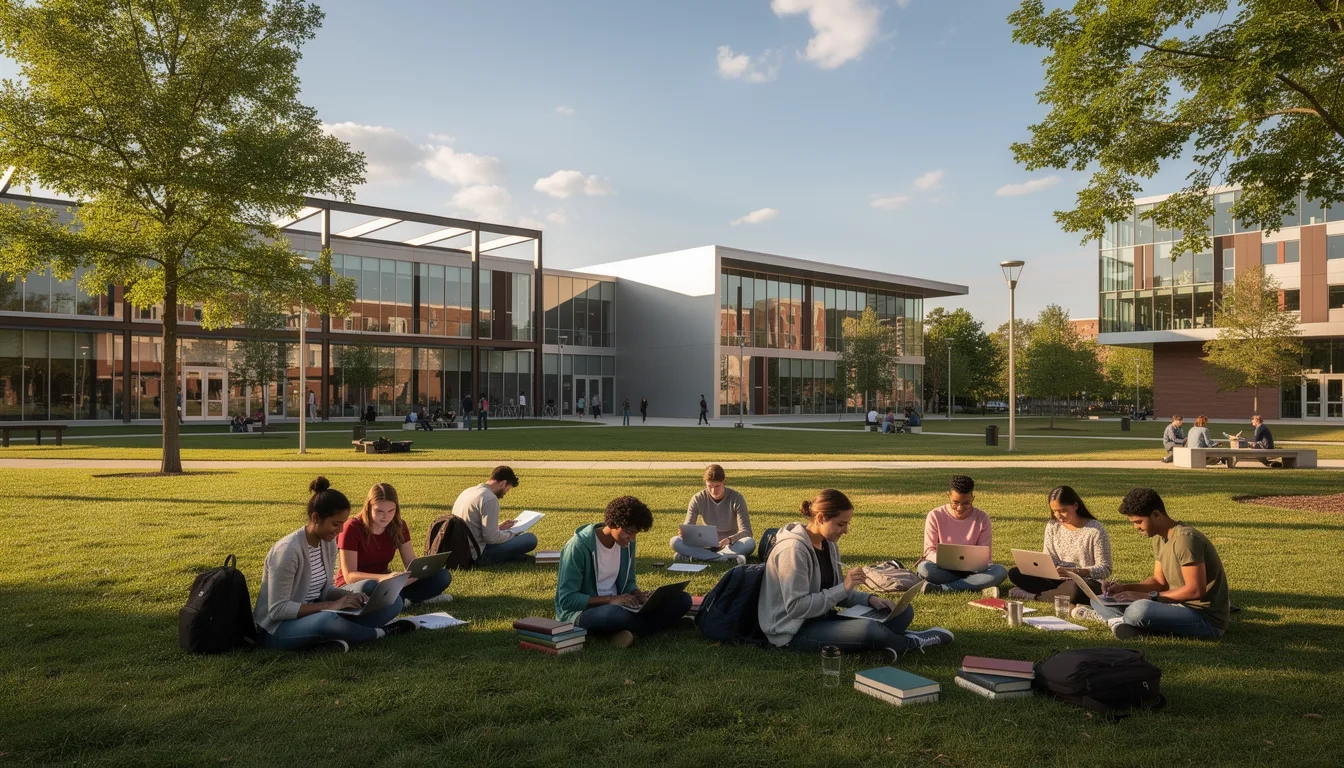
The main campus covers 444 acres in Columbia, South Carolina's state capital. Total enrollment is 35,471 students — large enough that you'll still meet new people as a senior, organized enough that departments and colleges create real sub-communities within the larger whole.
Student organizations exceed 650, spanning Air Force ROTC, a student-run symphony orchestra, competitive esports, and everything between. The campus radio station, WUSC-FM, has operated since the 1940s and still attracts student DJs. Dance Marathon, the annual charity endurance event, has run long enough that its presence on campus feels permanent rather than trend-dependent.
Most freshmen and sophomores live on campus. Upperclassmen tend to migrate to the Five Points or Vista neighborhoods, both within walking distance. The Thomas Cooper Library — USC's main research facility across a six-library system — runs 24 hours during finals. Dining spans more than 30 options, from the Russell House food court to standalone restaurants and food trucks, with expanded plant-based offerings that have grown noticeably in the past two years.
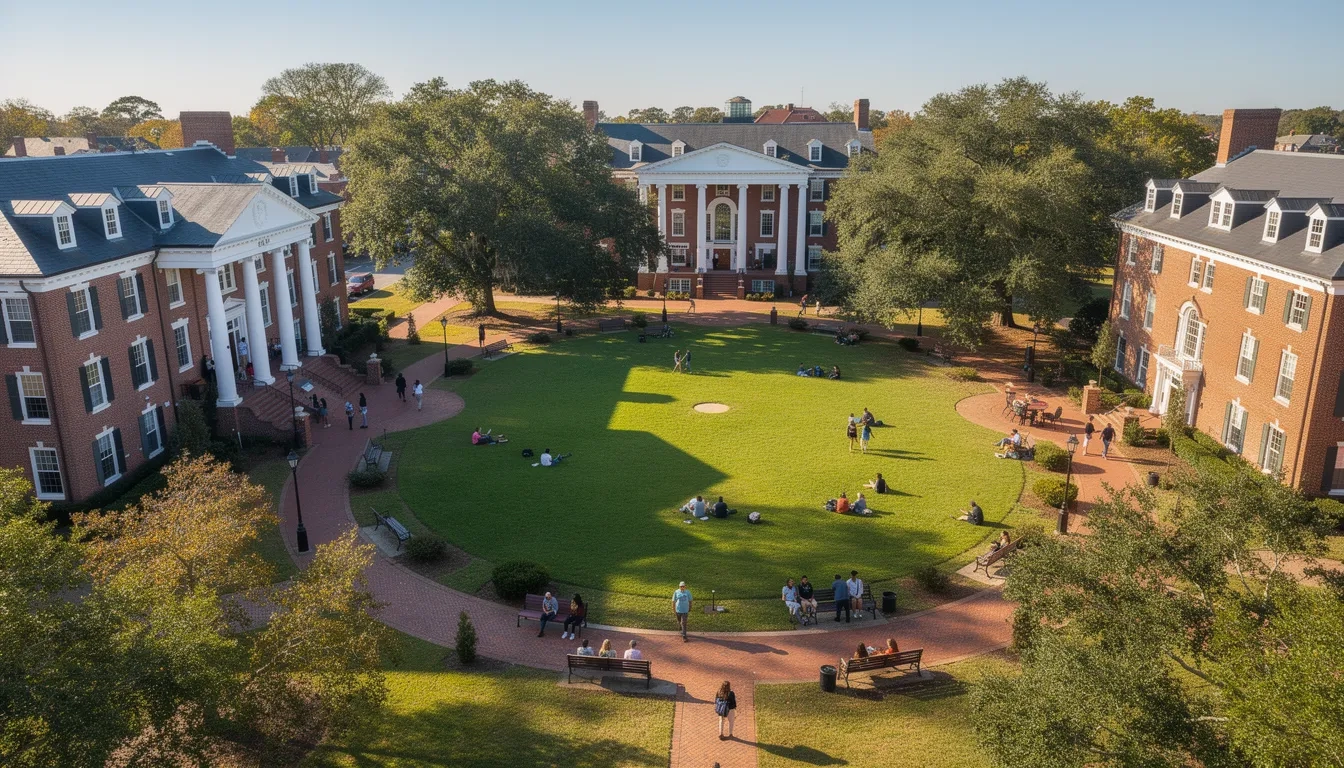
The Horseshoe, USC's historic central quad framed by antebellum-era buildings, is where students end up on warm afternoons. It's the geographical center of campus identity in a way that maps can't fully convey.
Gamecock Football: The Defining Fall Ritual
Williams-Brice Stadium holds 77,559 fans. Most SEC home games fill it. When "Sandstorm" by Darude hits the speakers before kickoff and 77,000 people lift rally towels at once, it lands differently than reading about it. The whole building vibrates.
The Gamecock Walk happens roughly 2.5 hours before kickoff — fans line the path to cheer the team into the stadium. Sir Big Spur, the live gamecock mascot (one of the few live animal mascots in college football), makes appearances for photos. Student tickets are free, but they're distributed through the Cockpit app's points system. Students earn points by attending other Gamecock athletic events throughout the year, which smartly boosts attendance at volleyball, swimming, and soccer games that would otherwise draw sparse crowds.
The Tailgate on Greene Street runs before every home game with free food and games, right on campus. Free shuttles depart from three pickup locations starting four hours before kickoff.
The Clemson rivalry — the Palmetto Bowl — operates on its own emotional register. The week leading up to that game takes on a culture of its own, and the outcome shapes how the entire season feels in retrospect. It is, genuinely, the writing on the wall for how fall ends in Columbia.
The football culture is real. It's also not the complete picture. Students who arrive expecting nothing but a party scene tend to be surprised by how much else exists — 650+ organizations, Honors College programming, research opportunities, and the Carolina Experience infrastructure. USC has built a full academic environment that operates independently of what happens on fall Saturdays.
Academic Support and the Carolina Experience
USC launched the Carolina Experience office in 2024 around one concrete idea: every student gets a peer leader. Students at the sophomore level and above are matched with trained upper-level or graduate students for one-on-one consultations and direct connections to campus resources. It's the University 101 philosophy extended beyond the first year.
Nursing students complete clinical placements at Prisma Health's hospital network, one of the largest health systems in South Carolina. Those hours feed directly into the NCLEX outcomes data behind USC's #22 nursing ranking.
Moore School students in international business complete a semester abroad as a graduation requirement — not an elective. The program maintains partnerships in more than 40 countries. For students targeting multinational careers, that built-in requirement is a feature, not a burden.
The academic infrastructure at USC rewards students who seek it out. The peer mentorship program, the Honors College's senior thesis option, the Goldwater Scholar pipeline for research-focused students — none of it falls into your lap. But it's all there.
Bottom Line
USC is a stronger school than #127 implies. For international business or nursing, you're looking at programs that outperform schools ranked fifty spots higher. The first-year experience infrastructure is the best among public universities in the country, and that advantage compounds over four years in ways that show up in graduation rates.
- Apply early action by October 15 — it signals interest and gets you a decision faster
- A 3.5+ GPA is your realistic baseline — below that, everything else in your application needs to work harder
- Apply separately to the Honors College if you want a smaller, intellectually intensive experience inside a large university
- Take the Moore School's 27-year #1 ranking seriously — it's the more accurate signal of what USC delivers than the overall national rank
- If nursing or international business is your direction, USC belongs on your serious list — not just as a fallback
Frequently Asked Questions
Is the University of South Carolina test-optional for 2026 applicants?
Yes. USC does not require SAT or ACT scores for undergraduate admission. You can still submit them — a strong result above the middle 50% range can strengthen your application — but leaving scores off your application won't count against you automatically.
What GPA do you realistically need to get into USC?
There's no published minimum, but 78% of enrolled freshmen had a high school GPA of 3.5 or higher. That's the practical baseline for solid admission odds. Below 3.0, admission is unlikely without exceptional circumstances elsewhere in the file.
Is the Darla Moore School's #1 international business ranking legitimate?
Yes, and the methodology backs it up. US News determines this ranking through peer assessments by business school deans and senior faculty at accredited programs nationwide — not alumni surveys or employer polls. Moore has held this specific ranking every year since the late 1990s. That consistency shows up in recruiting: multinational companies specifically target Moore graduates for international roles.
How hard is it to get into the South Carolina Honors College?
Considerably harder than general USC admission. The Honors College requires a separate application and admits a small fraction of the overall entering class. Students with 4.0+ GPAs, rigorous AP or IB coursework, and compelling essays are the typical admits. The payoff includes the BARSC-M.D. accelerated medical pathway, the option to design a custom major, and a tighter community of 13,000+ alumni than general enrollment offers.
What is "Sandstorm" at USC football games?
It's Darude's 1999 electronic track played over Williams-Brice Stadium's sound system before every home game kickoff, while students wave free rally towels in sync. The tradition took hold in the early 2000s and is now inseparable from the Gamecock game-day identity. Even students with no strong interest in football tend to know it by October of their first year.
Does USC offer merit scholarships for out-of-state students?
Yes. USC has multiple merit scholarship programs that can reduce out-of-state tuition, including the Carolina Scholars program for top academic achievers. Eligibility thresholds typically track GPA and test score benchmarks. Check directly with the USC Office of Undergraduate Admissions for current award amounts, as the specific figures change year to year.
Sources
- US News: USC retains top rankings in international business, first-year student experience
- University of South Carolina Admissions — CollegeData
- A guide to Gamecock gameday — USC News & Events
- USC Gamecock Traditions — The Daily Gamecock
- South Carolina Honors College — USC
- University of South Carolina Acceptance Rate 2025 — Shiksha