Vanderbilt University: Admissions, Rankings, and Student Life
In March 2026, Vanderbilt sent acceptance letters to 1,382 students out of 48,720 regular decision applicants. A 2.8% admit rate. For context, that number puts Vanderbilt's RD pool on par with or more selective than most Ivy League schools, yet families still slot it as a "likely" on college spreadsheets. The goalposts have moved. A lot of applicants just haven't noticed.
The Acceptance Rate Has Gone Off a Cliff
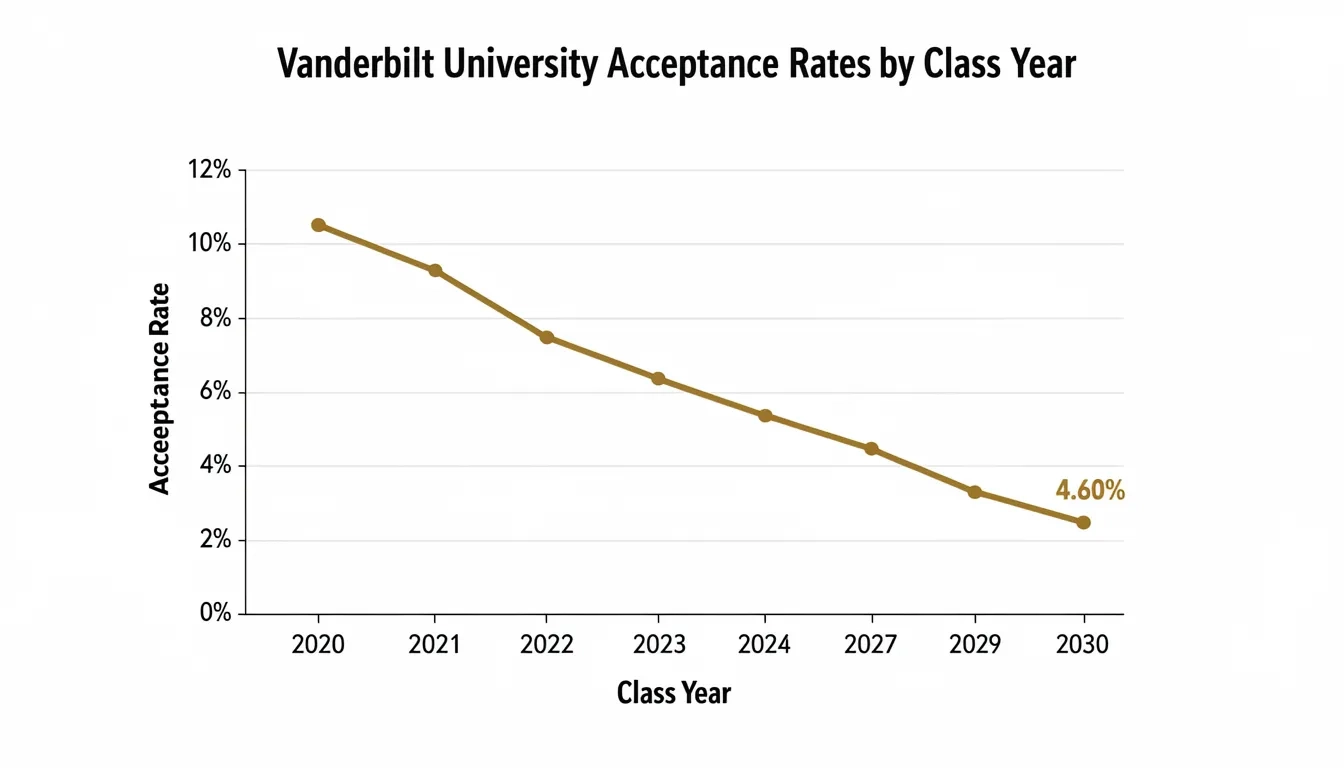
Vanderbilt's overall acceptance rate for the Class of 2030 landed at 4.60%, a record low. The trajectory is steep: the Class of 2020 saw roughly 12.5% admitted. By the Class of 2024, it was around 9.1%. Class of 2027 dropped to 6.7%. Now 4.60%.
Application volume explains most of this. Test-optional policies lowered submission friction, Common App expansion reached more international students, and Vanderbilt's rising national profile drew applicants who previously wouldn't have tried. The incoming class size stayed roughly flat at around 1,600 freshmen per year. Applicant numbers did not.
The early decision numbers tell a different story. ED applicants for the Class of 2030 were admitted at 11.9%, compared to a 2.8% RD rate. That's approximately a 4x advantage. Applying early decision when Vanderbilt is a genuine first choice is not admissions strategy theater — it's arithmetic.
What the Admitted Class Actually Looks Like
Among enrolled students who submitted test scores (about 52% of the class), the SAT middle 50% ran from 1510 to 1560, with the 75th percentile at 1560. ACT scores clustered at 34 to 35. These ranges don't make you stand out; falling below them makes you an outlier.
GPA tells the same story. Average high school GPA was 3.89. 40.2% of score-submitting enrolled students had a 4.0 unweighted. Another 51.9% fell between 3.75 and 3.99. Roughly 90% of the enrolled class graduated in the top 10% of their high school.
Vanderbilt has said publicly that strong grades and scores "are the baseline, not the differentiator." What actually separates applicants is harder to quantify: authentic intellectual curiosity in the essays, sustained engagement with a specific field, and evidence that you'll use Nashville as a resource rather than just a backdrop. With most competitive applicants checking the same academic boxes, the rest of the file does the actual work.
Rankings: What #17 Means in Practice
US News ranked Vanderbilt #17 among National Universities in its 2026 edition, moving up one spot from a previous three-way tie with Rice and UCLA. One slot doesn't sound dramatic. But the top-20 bracket functions differently than the top-30 with employers, fellowship committees, and graduate admissions in ways that compound over a career.
The 8:1 student-to-faculty ratio matters more than the headline rank number. Many research universities at comparable selectivity run 10:1 or 13:1. Smaller seminar access directly affects research opportunities, the depth of recommendation letters, and the kind of faculty relationships that drive competitive graduate placements.
Graduate rankings reinforce the undergraduate reputation independently. A few programs that carry strong national standing on their own:
- Peabody College of Education: consistently top 5 nationally by US News
- Vanderbilt University Medical Center: top-tier medical school for both research and primary care
- Law School: nationally ranked top 15-20 range
- Blair School of Music: nationally recognized in performance and composition
Vanderbilt also places 66th in QS World University Rankings, though for students targeting U.S. careers, the domestic #17 is the number that actually circulates.
Opportunity Vanderbilt: The Part That Changes the Math
Vanderbilt's 2025-2026 tuition is $67,934, with total annual costs (fees, room, and board) reaching approximately $94,274. Most families stop calculating there. They shouldn't.
The Opportunity Vanderbilt program removes loans entirely from all need-based financial aid packages. Every dollar of need-based aid arrives as grants, scholarships, or work-study. In 2024-25 alone, Vanderbilt distributed $65.2 million in aid to first-year students. The average need-based award for new students ran to $75,271 in the last reporting cycle — a number that consistently surprises families who assumed they earned too much to qualify.
For families in middle-income brackets, Vanderbilt can end up cheaper out of pocket than a state flagship after aid. The school meets 100% of demonstrated financial need (a promise fewer than 50 universities in the country can actually keep). Three merit scholarships — Ingram, Cornelius Vanderbilt, and Chancellor's — provide full tuition plus stipends for research and study abroad to selected applicants each year.
The practical implication: don't calculate affordability from the sticker price. Submit the FAFSA and CSS Profile, see the real number, and then decide.
Nashville Is Not a Coincidence
Vanderbilt sits on 340 acres in the middle of Nashville, one of the fastest-growing major cities in the U.S. over the past decade. The city's healthcare sector alone creates an unusually strong pipeline for pre-med and health policy students. HCA Healthcare, one of the nation's largest hospital systems, is headquartered downtown; the broader Nashville Health Care Council connects Vanderbilt students to internships across dozens of companies and health systems in ways most peer schools can't replicate.
The music and entertainment industry feeds a different kind of access. Students at the Blair School of Music or pursuing entertainment entrepreneurship can build real industry relationships inside one of the world's most active music markets.
Beyond career pipelines, Nashville is a functioning city that raises the ceiling on what a Vanderbilt education actually includes. Live music runs seven nights a week. The restaurant scene is legitimate. Off-campus cost of living is lower than comparable university cities like Boston or the Bay Area. Students who engage the city regularly describe a richer four years than those who stay within the campus bubble.
Campus Life: What It's Actually Like Day to Day
Every first-year student at Vanderbilt lives in Ingram Commons, a cluster of 10 residential houses grouped around a shared center with dining, study rooms, and a gym. The design creates a forced cohort: most freshmen build lasting relationships before they've declared a major. Alumni consistently identify Ingram Commons as the reason Vanderbilt friendships form faster than at schools where first-years scatter across campus.
Greek life touches roughly 35-40% of students. Organizations log over 35,000 hours of community service annually. Sororities operate from Panhellenic spaces rather than residential houses, which significantly reduces the all-or-nothing social pressure common at schools where Greek affiliation controls your living situation.
Vanderbilt competes in the SEC as a Division I athletics program. Vanderbilt baseball has won national championships and regularly fields one of the strongest programs in the country. Campus newspaper The Vanderbilt Hustler broke the Class of 2030 admissions story in real time, which gives you a sense of the editorial culture. 85% of students report feeling extremely safe on campus — a meaningful data point for a 340-acre campus embedded inside a major American city.
Here's how Vanderbilt compares on the dimensions that matter most:
| Factor | Vanderbilt (2026) | Peer Context |
|---|---|---|
| Overall Acceptance Rate | 4.60% | Comparable to Penn, Dartmouth |
| ED Acceptance Rate | 11.9% | ~4x the RD rate |
| SAT Middle 50% | 1510–1560 | Near Ivy-level range |
| Student-Faculty Ratio | 8:1 | Better than most top-20 peers |
| Average Need-Based Grant | $75,271 | Meets 100% of demonstrated need |
| US News Rank (2026) | #17 National Universities | Up from three-way tie at #18 |
Vanderbilt has said publicly that strong grades and scores function as a baseline, not a differentiator. The application that gets you in is the one that shows what you'll do with the access.
Students who thrive at Vanderbilt tend to share a few traits beyond their test scores: genuine curiosity that crosses disciplines, comfort engaging Nashville beyond the campus gates, and identities built around more than their intended major. The school rewards ambitious people who haven't narrowed themselves prematurely.
Bottom Line
- Apply early decision if Vanderbilt is your genuine first choice. An 11.9% ED rate versus 2.8% RD is not a subtle difference — and it's one of the few structural levers applicants actually control.
- Run the financial aid numbers before deciding it's unaffordable. The Opportunity Vanderbilt program eliminates loans and distributed $65.2 million to a single freshman class. Many middle-income families pay less than they would at a state school.
- Treat Vanderbilt as a true reach. A 4.60% overall rate means there are no sure things, even with a 4.0 GPA and a 1570 SAT. Build your list accordingly.
- Factor in Nashville as a genuine career asset — the healthcare, music, and business ecosystems aren't brochure copy. They're functional pipelines.
- The 8:1 faculty ratio pays off most for students who actively pursue research, mentorship, and professor relationships. Show up for office hours.
Frequently Asked Questions
Is Vanderbilt part of the Ivy League?
No. The Ivy League is a specific athletic conference of eight northeastern universities; Vanderbilt competes in the SEC. But at a 4.60% overall acceptance rate, Vanderbilt's admissions are now comparable to or more selective than several actual Ivy League members. The brand distinction still exists in some employer contexts, but the academic profile and selectivity are in the same range.
What GPA and test scores do you realistically need to apply?
The SAT middle 50% for enrolled students runs 1510–1560, with a median ACT of 35. Average high school GPA is 3.89. These are medians, not cutoffs. Vanderbilt is test-optional through 2027, but among the 52% of enrolled students who submitted scores, the ranges skew very high. Submitting strong scores likely still helps. A weak application with a 1580 probably won't succeed; a strong application with softer scores can.
Does Opportunity Vanderbilt really eliminate loans?
Yes, for need-based aid. Vanderbilt's financial aid packages don't include loans for students with demonstrated financial need. Aid arrives as grants, scholarships, and work-study. Students can voluntarily request federal loans, but they won't appear in your package by default. The school meets 100% of demonstrated financial need — a commitment that sounds common and isn't.
What are Vanderbilt's strongest undergraduate programs?
Peabody College ranks top 5 nationally in education. The pre-med pipeline feeds directly into one of the South's strongest medical schools. Blair School of Music has a serious national reputation in performance and composition. Economics, political science, and engineering are well-regarded. The interdisciplinary structure makes it easier to combine fields than at more rigidly siloed programs.
How important is Greek life to the Vanderbilt social experience?
Significant but not mandatory. About 35-40% of students affiliate, giving Greek life real visibility on a campus of roughly 7,000 undergrads. But the Ingram Commons system builds strong freshman cohorts independent of Greek involvement, and 500-plus student organizations offer genuine alternatives. Students who skip Greek life don't report social isolation — Nashville itself provides an outlet most campuses simply don't have.
What should I do if I get waitlisted at Vanderbilt?
Vanderbilt's waitlist acceptance rate has historically been low, often under 5%, and potentially lower given record-low overall admit rates. Being waitlisted means you met the academic threshold — that's real. But treat it as a long shot. Enroll at your best admitted school, send a concise letter of continued interest with any meaningful updates, and build genuine enthusiasm for where you did get in.
Sources
- Record-low 2.8% of applicants admitted to Class of 2030 – The Vanderbilt Hustler
- Vanderbilt Admissions Statistics 2025 – The Koppelman Group
- Vanderbilt rises one spot in 2026 U.S. News Ranking to No. 17 – The Vanderbilt Hustler
- Affordability | Undergraduate Admissions | Vanderbilt University
- Undergraduate Tuition and Fees 2025–2026 | Vanderbilt University
- Vanderbilt University – Profile, Rankings and Data | US News Best Colleges
- Vanderbilt Acceptance Rate: Class of 2030 Admissions Statistics | AdmissionSight