VR in College Classrooms: What the Research Actually Shows
In spring 2024, 200 students at the University of Waterloo's Stratford School of Interaction Design and Business put on VR headsets and began sculpting 3D characters with their bare hands using software called Gravity Sketch. No clay. No screen. Just hands in virtual space, shaping geometry the way a potter shapes clay. Dr. Ville Mäkelä's team published the findings at the 2025 CHI Conference on Human Factors in Computing Systems. The results were messy, exciting, and more complicated than the usual hype — which is exactly what makes them worth examining.
The Schools Already Doing This (Not Just Piloting It)
The adoption numbers are still modest. Only 14 percent of college administrators say their institutions have made meaningful investments in VR or immersive learning — though that number jumped seven percentage points in a single year. Something is clearly shifting.
The most compelling proof comes from Arizona State University. Starting in fall 2022, ASU required all STEM majors to complete introductory biology labs through Dreamscape Learn, a company that produces 15-minute immersive alien-wildlife-rescue scenarios experienced through a headset. A longitudinal study tracking more than 4,000 students found the VR cohort improved their final biology grade by one-quarter of a letter grade compared to pre-VR students.
They were also 1.7 times more likely to score between 90 and 100 percent on lab assignments. And STEM retention improved: the share of Biology 181 students who switched out of the School of Life Sciences dropped from 29 percent before VR (2018–2022) to 24 percent after it was introduced. That's the kind of data that moves institutional budgets.
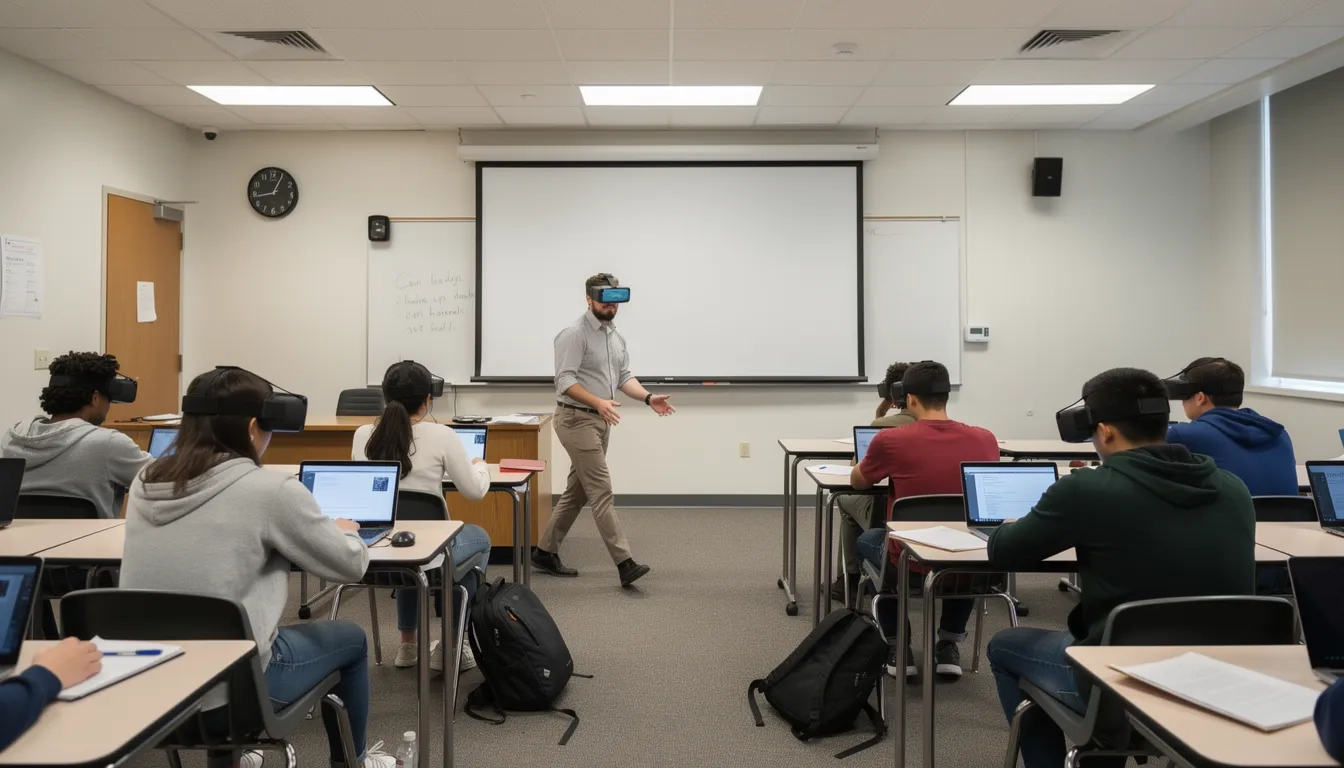
At Michigan State University, Professor Rabindra "Robby" Ratan takes a different approach. He teaches two courses almost entirely inside a VR metaverse platform called Engage, managing roughly 130 Meta Quest 2 headsets that students borrow for home or classroom use. The courses — "Understanding Virtual Reality Experiences" and "Avatar Psychology" — are hybrid by design, with 8 required in-person sessions per semester.
Ratan's most-cited observation: students cannot multitask in VR. No scrolling Instagram during lecture. No half-open Gmail tab sitting behind the slides. The headset creates a focused cognitive environment that Zoom never managed. Students, he says, are "happier about class" compared to fully remote alternatives.
The Disciplines Where VR Actually Clicks
Not every subject benefits equally. The research pattern is consistent: VR works best when the alternative is expensive, dangerous, or physically impossible to replicate at scale.
High-stakes clinical simulation is the most documented win. At UNC Greensboro's Bryan School of Business, nursing students practice needle insertion and heart anatomy without touching a patient. At the University of Pittsburgh, pharmacy students interact with digital cardiovascular models and watch in real time how medications alter artery behavior. These are scenarios where a mistake in the real world has real consequences.
Spatial reasoning and 3D design are another clear fit. The Waterloo study showed that VR gives students an intuitive grasp of three-dimensional form that flat-screen software simply cannot replicate. Architecture and industrial design programs are migrating toward this for the same reason.
Communication skills are the less obvious but fast-growing category. Indiana University Indianapolis deploys Meta Quest II headsets with VirtualSpeech software, letting students practice public speaking in front of AI-generated audiences on simulated TED Talk stages and boardroom settings. The software gives real-time feedback on pacing, eye contact, and filler words. William and Mary runs similar setups for counselor training — the stress response students feel in front of a virtual audience turns out to be real enough to be pedagogically useful.
Here's where the clearest traction exists across disciplines:
| Discipline | VR Application | Key Benefit |
|---|---|---|
| Nursing / Medicine | Patient simulation, anatomy | Practice without patient risk |
| STEM / Biology | Lab simulations (ASU Dreamscape Learn) | Higher grades, improved retention |
| Communication | Public speaking practice (VirtualSpeech) | Real-time AI feedback, low-stakes repetition |
| Criminal Justice | Mock trials, crime scene evaluation | 360-degree perspective on complex scenarios |
| Supply Chain / Business | Warehouse and logistics walkthroughs | Industry exposure without travel cost |
| Design / Architecture | 3D modeling in VR (Gravity Sketch) | Spatial intuition impossible on a flat screen |
What the Research Actually Shows
The engagement numbers are almost universally positive. Studies consistently find that students in VR report higher motivation, stronger emotional connection to material, and more active participation than in traditional settings. A 2024 critical review published in Frontiers in Psychology, analyzing 33 peer-reviewed articles from 2014–2023, confirmed that VR promotes genuine cognitive engagement with complex and abstract concepts.
But here's the thing: engagement is not the same as learning.
A University of Kansas study found that students who learned with augmented reality reported feeling more engaged than students who watched the same content on video. On actual knowledge assessments, the video group scored higher. That finding should give anyone designing VR curriculum serious pause. The experience of immersion can feel educational without being educational.
The honest question isn't "Do students enjoy VR?" They almost always do. The real question is whether what happens in the headset transfers to what students can do outside it.
The ASU Dreamscape data matters precisely because it doesn't stop at satisfaction scores. A median student rating of 5 out of 5 is nice — but the grade improvement and STEM retention numbers are what make it actionable for an administrator justifying a budget line. Procedural and experiential learning shows consistent gains. Purely conceptual delivery (a 360-degree tour of ancient Rome for a history course) has much weaker evidence behind it.
The Real Obstacles
The barriers are significant. Cost is the most visible. A single Meta Quest 3 headset runs $499. A classroom set of 25 units hits $12,475 in hardware before any platform licensing, IT provisioning, instructor training, or content development. Realistic first-year pilot budgets at institutions without outside funding tend to land somewhere north of $40,000.
UNC Greensboro offset this with a $1 million Google grant through the Cybersecurity Clinics Fund, part of a $25 million collaboration with the Consortium of Cybersecurity Clinics. Most schools don't have that runway.
Simulator sickness is more serious than vendor brochures admit. At Michigan State, Ratan caps VR sessions at approximately 35 minutes precisely because of it. Some students experience nausea severe enough to need a non-VR alternative (which is the right call, but it complicates any VR-first curriculum design). Newer hardware has reduced the problem; it hasn't eliminated it.
Campus IT departments have been a surprising bottleneck. At UNC Greensboro, IT initially blocked VR headsets from the campus network entirely. Getting them online required Mobile Device Management integration, security protocol updates, and policy revisions. None of that moves fast at a large institution.
Teacher training is the quietest gap. The Frontiers in Psychology review found that instructor unfamiliarity with VR hardware and content tools is one of the biggest factors holding adoption back. Running a Zoom class is one thing. Managing an avatar in a virtual lecture hall while monitoring student presence and handling live tech questions is something else.
What Good Implementation Looks Like
Institutions getting consistent results share a few practices. None of them tried to go campus-wide first.
Target one high-value use case. ASU didn't deploy VR across all of biology — they started with introductory labs where the physical lab was already a bottleneck. UNC Greensboro focused on communication gaps in a specific program with grant backing. Trying to go broad first is how institutions end up with 30 dusty headsets in a storage room.
Design for the student who hates VR. Ratan's hybrid model, with 8 required in-person sessions and non-VR participation options, ensures no student is locked out by motion sickness or access issues. This isn't just nice to have — it's how you avoid ADA and equity complaints before they start.
Involve IT before purchasing anything. The UNC Greensboro experience shows that network throughput assessments and MDM provisioning need to happen before a single headset is ordered, not after the boxes arrive.
Measure learning, not just satisfaction. Student surveys will almost always show VR is "more engaging." What matters is pre/post knowledge assessments and skill transfer to real tasks — not whether students gave it five stars.
Plan for the 35-minute ceiling. Long VR sessions degrade into discomfort. Structure VR as a targeted activity inside a class period, not a replacement for the whole period.
The Cost Picture Over Time
The global VR-in-education market is projected to grow from $4.40 billion in 2023 to $28.70 billion by 2030. That kind of growth puts consistent downward pressure on hardware costs. Meta Quest headsets have already dropped substantially from the first-generation Rift era.
The more interesting question is total cost per learning outcome. If a Dreamscape VR lab session costs more per student than a traditional bench lab but produces meaningfully better STEM retention, the math might still favor VR. Most institutions haven't run that calculation yet. They're still thinking in terms of hardware sticker price.
As headset costs drop and pre-built content libraries grow, the marginal cost of adding a VR module to an existing course will fall. The Waterloo Gravity Sketch pilot required significant instructor setup time. A course running Dreamscape Learn's pre-built scenarios does not. That distinction matters for anyone building a business case.
Ratan's Avatar Summer School model is worth watching — offering VR courses to non-enrolled learners globally at $200 per student could change the economics for institutions willing to think beyond their own campus population.
Bottom Line
VR in college classrooms is no longer a novelty project, but it's not ready to replace the lecture hall either. Here's what the evidence actually supports:
- Use it for procedural simulation where repetition matters and real-world practice is expensive or dangerous: nursing, pharmacy, public speaking, hands-on lab work.
- Don't mistake engagement for learning. The University of Kansas AR counterexample exists. Pair immersive experiences with assessments that measure real skill transfer, not satisfaction surveys.
- Start narrow. One course, one department, one clearly defined learning problem. Prove it works there before expanding.
- Get IT in the room before ordering headsets. Campus network security is a genuine blocker, and MDM provisioning takes longer than anyone expects.
- Respect the 35-minute ceiling. Structure VR as a targeted activity inside a class period, not the whole thing.
My honest read: VR will become standard in a handful of disciplines over the next decade — clinical training, safety-critical fields, 3D design. Everywhere else, it'll be a useful supplement at best. The institutions that get the most from it will be the ones treating it as a precision tool for specific learning problems, not a wholesale reimagining of how college works.
Frequently Asked Questions
Is VR actually more effective than traditional teaching methods?
For procedural learning — nursing simulations, biology labs, public speaking practice — VR consistently outperforms passive alternatives in both retention and grade outcomes. For conceptual content delivery, the evidence is mixed: a University of Kansas study found AR-equipped students felt more engaged but scored lower on assessments than students who watched video. The type of learning task matters as much as the technology itself.
How much does it cost to set up VR in a college classroom?
A basic deployment of 25 Meta Quest 3 headsets runs $12,475 in hardware alone. Add platform licensing, IT provisioning, instructor training, and content development, and a realistic first-year pilot sits north of $40,000. Some institutions have offset this through corporate partnerships (ASU with Dreamscape Learn) or grants — UNC Greensboro received $1 million through Google's Cybersecurity Clinics Fund specifically to fund immersive learning programs.
What is simulator sickness and how serious a problem is it?
Simulator sickness is essentially motion sickness caused by the disconnect between visual movement in a headset and your body's physical stillness. Michigan State's Rabindra Ratan caps VR sessions at around 35 minutes specifically because of it, and some students experience it severely enough to need alternative participation options entirely. Newer headsets have improved the situation, but it hasn't been solved. Any course design that doesn't account for it will run into problems.
Which majors benefit most from VR in the classroom?
Clinical health fields (nursing, dentistry, medicine), STEM lab courses, 3D design and architecture programs, and communication and public speaking courses have the strongest documented outcomes. Criminal justice and supply chain management programs are close behind. Fields built around abstract conceptual understanding — philosophy, literature, economics — have much weaker evidence, though some experimental applications exist.
Do students need to own their own VR headsets?
Not typically. Most university programs using VR run a lending model — headsets checked out like library books. Michigan State maintains approximately 130 Meta Quest 2 devices in its pool. Some schools operate dedicated VR labs where students book sessions on-site. Bring-your-own-device is uncommon because personal headset ownership among college students remains low across most income brackets.
Is there a risk that VR widens equity gaps between students?
Yes, and it's worth taking seriously. VR-first course designs can disadvantage students who experience severe simulator sickness, students with certain vestibular conditions, and students with limited campus access. The institutions handling this best build non-VR alternatives into course design from the start — MSU's hybrid model is the clearest example. Treating VR as the only path through a course, rather than one modality among several, is where equity problems tend to emerge.
Sources
- Large-scale study reveals true impact of ASU VR lab on science education — ASU News
- ASU's Required Virtual Reality Lab Boosted Grades, Retention — Inside Higher Ed
- Seven Examples of Students Learning With Virtual Reality — Inside Higher Ed
- Teaching College Courses in a Virtual Reality Environment — Inside Higher Ed
- Immersive AI and VR Experiences Bridge the Skills Gap in Higher Education — EdTech Magazine
- First Large-Scale VR Use in the Classroom Extends the Boundaries of Education — Phys.org
- The Impact of Virtual Reality on Student Engagement in the Classroom — Frontiers in Psychology / PMC